Washington Panic Button Law: What Hotels, Retail, and Security Employers Need to Know

The Washington panic button law is officially in effect, and businesses across the state are now required to take immediate action to protect their isolated workers. Signed into law by Governor Bob Ferguson on April 16, 2025, House Bill 1524 (H.B. 1524) mandates that employers in specific industries provide panic buttons to employees who work alone or in areas where help isn’t immediately accessible (1).
This groundbreaking legislation targets industries where workers face elevated risks of workplace violence, sexual harassment, and assault—including hotels, motels, retail establishments, security guard entities, and property services contractors. If your organization falls within these categories, understanding the requirements of this law is essential to staying compliant and, more importantly, keeping your employees safe.
In this guide, we’ll break down everything you need to know about the Washington panic button law: what it requires, who must comply, the penalties for non-compliance, and how to choose a panic button solution that meets the legal standards. Whether you manage a hotel, oversee a retail operation, or run a janitorial services company, this article will help you navigate the new requirements with confidence.
What Is the Washington Panic Button Law (H.B. 1524)?
House Bill 1524, commonly referred to as the Washington panic button law, is a workplace safety legislation designed to protect isolated employees from violence, sexual harassment, and assault while on the job. The bill was signed into law by Governor Bob Ferguson on April 16, 2025, and officially took effect on January 1, 2026.
The law was enacted in response to growing concerns about the safety of workers who spend significant portions of their shifts alone or in locations where immediate assistance from coworkers or supervisors isn’t available. Housekeepers, janitors, retail associates, and security guards are among the workers most vulnerable to these risks, often encountering potentially dangerous situations without backup nearby.
At its core, H.B. 1524 requires covered employers to provide panic buttons to their isolated employees. These devices must allow workers to quickly summon help in the event of an emergency—whether that’s a physical threat, harassment, or another dangerous situation. The law also establishes requirements for employee training, recordkeeping, and providing workers with resources related to harassment and assault prevention.
By placing the responsibility on employers to equip and train their workforce, the Washington panic button law aims to create a safer environment for some of the state’s most at-risk employees. For businesses, this means taking proactive steps to implement compliant solutions before facing potential fines and, more critically, before an incident occurs.
Who Must Comply With H.B. 1524?

The Washington panic button law applies to employers in specific industries where workers commonly face isolated working conditions and elevated safety risks. If your business operates within any of the following sectors, you are required to comply with H.B. 1524.
Hotels and Motels
Housekeepers and other hospitality staff frequently work alone in guest rooms and corridors, making them particularly vulnerable to harassment or assault. The Washington panic button law recognizes these risks and requires hotel and motel employers to equip isolated workers with panic buttons and proper training.
Retail Establishments
Retail workers—especially those working early morning, late night, or in stockrooms and fitting areas—often find themselves without immediate access to coworkers or supervisors. Under H.B. 1524, retail employers must ensure these isolated employees have the tools they need to call for help instantly.
Security Guard Entities
Security personnel frequently patrol large properties alone, respond to incidents without backup, or monitor facilities during off-hours. The law mandates that security guard companies provide panic buttons to employees working in isolated conditions.
Property Services Contractors
Janitorial staff, cleaning crews, and other property services contractors often work in empty office buildings, schools, or commercial spaces after hours. These workers are now protected under the Washington panic button law and must be provided with panic devices and the required training.
Defining an "Isolated Employee"
It’s important to understand how the law defines an isolated employee. According to H.B. 1524, an isolated employee is someone who spends at least half of their working hours alone or who works in an area where two or more coworkers or supervisors are unable to immediately respond to a call of distress or emergency. If any of your employees meet this definition, they must be provided with a compliant panic button solution.
Key Requirements of the Washington Panic Button Law
H.B. 1524 establishes clear obligations for employers to protect their isolated workers. Understanding these requirements is essential for achieving compliance and avoiding penalties. Here’s what the law mandates.
Panic Button Provision
Employers must provide each isolated employee with a panic button, and employees are required to carry the device whenever they are working. Critically, the panic buttons must be simple to activate without delays caused by passwords, system startup, or complicated procedures. The goal is to ensure that workers can summon help immediately when facing an emergency—every second counts in a dangerous situation.
Mandatory Training
The law requires employers to provide training to managers, supervisors, and isolated employees. This training must cover several key areas, including the prevention of sexual assault, sexual harassment, and sexual discrimination. Employees must also be trained on how to properly use the panic buttons provided to them. Additionally, managers and supervisors must understand their responsibility to respond quickly and appropriately when a panic button is activated.
Documentation and Recordkeeping
Compliance doesn’t end with distributing devices and conducting training. Employers are required to document the completion of all mandatory training and maintain records of panic button purchases and usage. These records must be made available to the Washington State Department of Labor & Industries upon request. Property services contractors have an additional requirement: they must submit annual reports to L&I detailing their compliance efforts.
Resource Lists for Employees
Employers must provide isolated employees with a list of resources related to harassment and assault prevention. At a minimum, this list must include contact information for the Equal Employment Opportunity Commission (EEOC), the Washington State Human Rights Commission, and local advocacy groups focused on preventing sexual harassment and assault. This ensures workers know where to turn for support beyond their immediate workplace.
Penalties for Non-Compliance
Failing to comply with the Washington panic button law carries significant financial consequences. Employers who willfully violate the requirements of H.B. 1524 face a fine of $1,000 for each violation. For repeat willful offenders, the penalties escalate sharply—fines can range from $2,000 to $10,000 per violation.
These penalties are designed to ensure that employers take the law seriously and prioritize the safety of their isolated workers. Beyond the financial impact, non-compliance exposes organizations to increased liability in the event of a workplace incident. If an isolated employee is harassed or assaulted and the employer failed to provide a panic button or proper training, the legal and reputational consequences could be far more damaging than any fine.
The bottom line is clear: proactive compliance is far less costly than dealing with the aftermath of a violation or, worse, a preventable incident. Investing in a compliant panic button solution and training program now protects both your employees and your organization.
How to Choose a Compliant Panic Button Solution
Not all panic buttons are created equal, and choosing the right solution is critical to meeting the requirements of H.B. 1524. Here’s what to look for when evaluating panic button systems for your organization.
Simple, Immediate Activation
The Washington panic button law specifically requires that devices be easy to activate without delays from passwords or system startup. Look for a solution that allows one-touch activation so employees can call for help instantly, even in high-stress situations.

Portability
Isolated employees are often on the move—cleaning rooms, patrolling properties, or working across large retail floors. Your panic button solution should be portable and easy for workers to carry throughout their shift without interfering with their duties.
Reliable Alert Delivery
When a panic button is pressed, the right people need to know immediately. Choose a system that delivers alerts through multiple channels, such as text messages, phone calls, emails, or app notifications, to ensure supervisors and security personnel receive the alert no matter where they are.
GPS Location Tracking
In an emergency, knowing where the employee is located can be just as important as knowing that they need help. A panic button solution with GPS tracking enables responders to find and assist the worker as quickly as possible.
Documentation and Reporting Capabilities
Since H.B. 1524 requires employers to maintain records of panic button purchases and usage, selecting a solution with built-in reporting features can simplify compliance. This makes it easier to provide documentation to the Department of Labor & Industries if requested.
How Silent Beacon Helps Organizations Comply With the Washington Panic Button Law
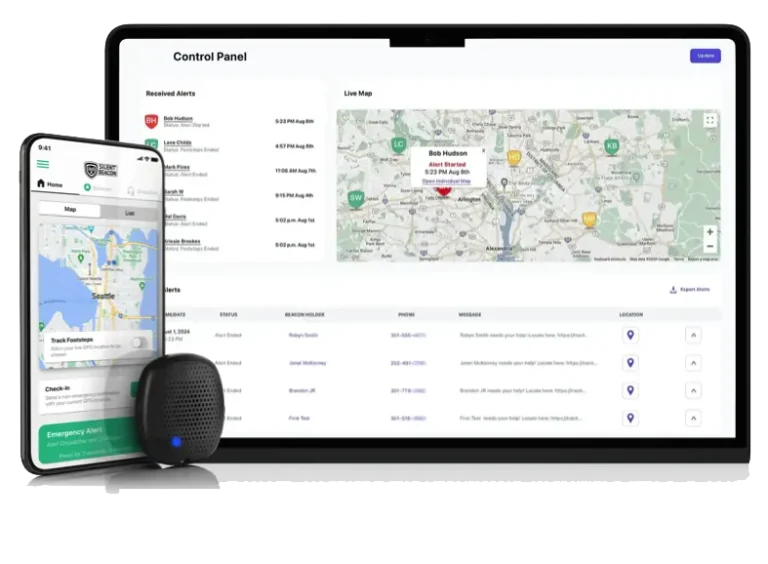
Silent Beacon’s panic button solutions are designed to meet the exact requirements of H.B. 1524, making compliance straightforward for hotels, retail businesses, security companies, and property services contractors across Washington state.
One-Touch Activation
Silent Beacon devices feature simple, one-touch activation that requires no passwords or delays. When an isolated employee faces an emergency, they can instantly alert designated contacts with a single press—exactly what the law requires.
Multi-Channel Alerts
When a Silent Beacon panic button is activated, customizable alerts are sent via text, phone call, email, and app notifications. This ensures that supervisors, security teams, or emergency responders are notified immediately through whatever channel they monitor most closely.
GPS Location Tracking
Every Silent Beacon device includes GPS tracking, allowing responders to pinpoint the exact location of the employee in distress. This feature is invaluable for workers spread across large hotels, retail locations, or commercial properties.
Easy Deployment Across Industries
Whether you’re outfitting housekeepers at a hotel, retail associates, security guards, or janitorial staff, Silent Beacon’s portable, wearable design makes it easy to deploy across your workforce. The devices are lightweight, durable, and simple for employees to carry throughout their shifts.
Peace of Mind and Liability Protection
Beyond compliance, implementing Silent Beacon provides peace of mind for both employers and employees. Your workers will feel safer knowing they have a direct line to help, and your organization will be better protected against liability in the event of an incident.
Schedule a Meeting with Our Safety Experts Today
Complete this simple form so we can prepare to tailor our safety solution options for your business and organization.
Key Takeaways
The Washington panic button law (H.B. 1524) represents a significant step forward in protecting isolated workers across the state. Here’s what you need to remember:
- The law is now in effect. As of January 1, 2026, employers in covered industries must comply with all requirements of H.B. 1524.
- Covered industries include hotels, motels, retail establishments, security guard entities, and property services contractors. If your business operates in one of these sectors, you are legally obligated to provide panic buttons to isolated employees.
- Panic buttons must be simple to activate without passwords or delays, and employees must carry them while working.
- Training is mandatory for managers, supervisors, and isolated employees, covering harassment prevention and proper panic button use.
- Documentation is required. Employers must maintain records of training and panic button purchases and usage.
- Penalties for non-compliance are steep. Willful violations can result in fines ranging from $1,000 to $10,000.
Compliance isn’t just about avoiding fines—it’s about creating a safer workplace for your most vulnerable employees. Taking action now demonstrates your commitment to their well-being and protects your organization from unnecessary risk.
Protect Your Workforce With Silent Beacon
If your organization is looking for a reliable, compliant panic button solution, Silent Beacon is here to help. Our devices are built to meet the requirements of the Washington panic button law, with one-touch activation, GPS tracking, multi-channel alerts, and easy deployment for hotels, retail, security, and property services teams.
Don’t wait until an incident occurs or a fine is issued. Contact Silent Beacon today to learn how our panic button solutions can help your organization comply with H.B. 1524 and keep your isolated employees safe.
- Washington State Legislature – Second Substitute House Bill 1524 (H.B. 1524)– Chapter 47, Laws of 2025. Effective January 1, 2026.