Workplace Violence in Healthcare: What the Numbers Mean for Home Health Leaders in 2026
The American Hospital Association estimates that workplace and community violence cost U.S. hospitals $18.27 billion in 2023 alone, with $14.65 billion absorbed in post-event costs including medical treatment for injured staff, lost productivity, and infrastructure repairs [1]. That figure represents hospitals: facility-based environments with security teams, badge access systems, and fixed panic buttons.
For home health agencies, where clinicians work alone in private residences without any of that infrastructure, the violence exposure is arguably worse, and the organizational cost of ignoring it is climbing.
April is Workplace Violence Prevention Awareness Month. For operations and risk leaders managing mobile clinical workforces, this isn’t an awareness exercise. It’s an operational question: what does your organization actually have in place when a clinician needs help and no one is within earshot?
A Systemic Problem, Not an Isolated One
Healthcare violence is not a series of unfortunate incidents. It’s a structural pattern driven by the nature of the work itself.
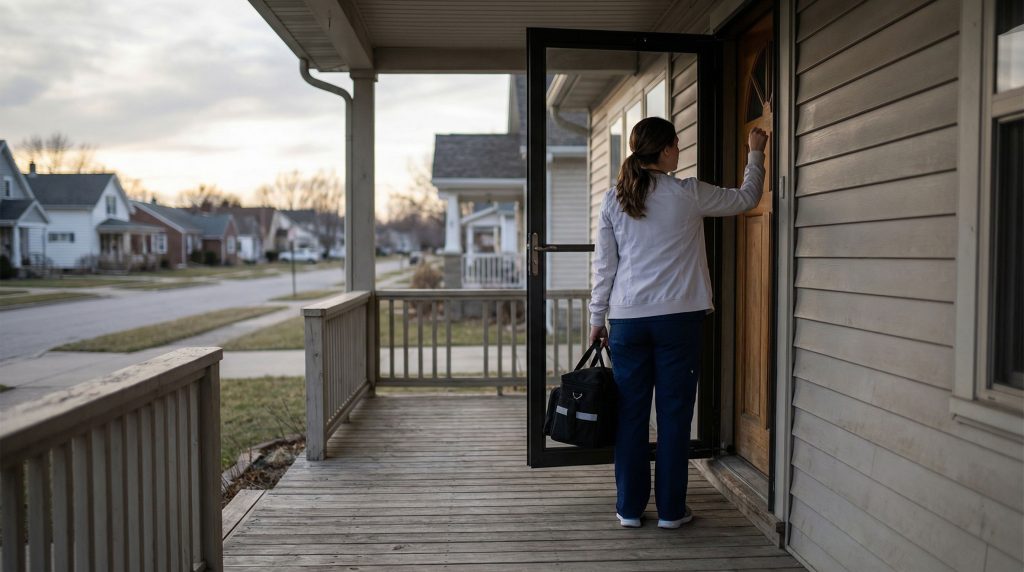
Home health clinicians perform an average of five to eight solo visits per day. Each visit places them in a private residence where conditions vary widely: unfamiliar neighborhoods, unstable household dynamics, patients or family members experiencing cognitive decline, substance use, or emotional crisis. Behavioral health clinicians face an even more acute version of this reality, routinely de-escalating individuals in psychosis, active substance abuse, or suicidal ideation.
The data on this exposure is stark. According to the CDC’s National Institute for Occupational Safety and Health (NIOSH), home healthcare workers face elevated risks across every violence category, with 18% to 65% reporting verbal abuse, 2.5% to 44% reporting physical assault, and 41% reporting sexual harassment [2]. Research from the American Association of Post-Acute Care Nursing (AAPACN) puts career-long exposure even higher: up to 87% of home health workers experience some form of violence over the course of their careers [3].
Contributing factors include isolation during visits, the presence of weapons or animals in homes, and patient conditions such as dementia and substance use disorders [2]. With the Bureau of Labor Statistics projecting 34% growth in home care employment by 2029, the population of clinicians facing these risks is expanding rapidly [2].
These numbers are widely understood to be underreported. NIOSH and AAPACN both note that many clinicians normalize verbal threats, intimidation, and low-level physical aggression as part of the job, particularly when their organization lacks a meaningful mechanism for reporting or response [2][3].
Why Facility-Based Prevention Doesn't Transfer
Most healthcare violence prevention programs were designed for controlled environments. Fixed duress buttons mounted under desks. Security personnel stationed at entrances. Badge-access systems and camera networks providing layered coverage.
None of these measures follow a clinician into a patient’s living room.
This is the fundamental gap home health and behavioral health leaders face. The safety infrastructure that works inside a hospital does not extend to the settings where mobile clinicians spend the majority of their working hours. And it’s in those settings, private homes, community locations, residential treatment facilities, where the risk concentration is highest.
The result is a protection gap. Organizations invest significantly in facility security while their most exposed employees operate with little more than a cell phone and a verbal check-in protocol.
The Compounding Cost of Inaction
The consequences of this gap go well beyond individual incidents. For leadership, unaddressed violence against mobile clinicians creates compounding organizational costs.
Turnover. A 2024 report covered by McKnight’s Home Care found that annual turnover costs average over $423,000 for a 100-worker home health agency, with 80% of turnover occurring within the first 100 days of employment [4]. That churn is not just a staffing problem; it strains earnings, reduces patient acceptance capacity, and correlates with workforce dissatisfaction, including 25% of workers reporting fair or poor general health and 20% reporting poor mental health [4]. For context, the 2025 NSI National Health Care Retention and RN Staffing Report puts the average cost to replace a single bedside RN at $61,110 across hospitals [5], and home health agencies are competing for the same clinical talent pool. When unsafe working conditions are consistently cited as a leading driver of departure, the financial exposure for agencies without meaningful field safety programs is severe and recurring.
Liability and regulatory pressure. Organizations carry a legal duty of care to provide a reasonably safe working environment. When a clinician is assaulted during a home visit and the organization’s safety plan consists of a buddy system or a verbal protocol, the liability position is difficult to defend. The Joint Commission’s National Performance Goals, effective January 1, 2026, place renewed emphasis on violence prevention and staffing for safe care in home settings. OSHA’s 2026 worker protection standards preview has prioritized violence prevention and lone worker policies for healthcare organizations.
Clinical performance. NIOSH research connects violence exposure directly to burnout, anxiety, and diminished clinical performance [2]. AAPACN’s analysis draws the same line from repeated exposure to psychological trauma and reduced care quality [3]. A clinician who feels unsafe entering a home visit is not performing at their best. Protecting your workforce and protecting your patients are the same initiative.
What a Modern Violence Prevention Plan Requires
An effective violence prevention plan has to be built for the environments where violence actually occurs. For home health organizations, that means extending protection beyond the facility and into the field, building safety infrastructure that travels with the employee.
One-touch alerting without phone interaction
In a crisis, requiring a clinician to locate their phone, unlock it, open an app, and place a call introduces dangerous friction. Wearable safety devices paired to an employee’s smartphone enable single-press activation of emergency alerts, including direct 911 calls, without the clinician ever touching their phone. This distinction matters: most mobile safety apps still require unlocking and navigating the phone during an emergency. A dedicated wearable device removes that barrier entirely.
Silent activation for escalating encounters
Some of the most dangerous moments for clinicians are slow escalations: a family member becoming increasingly agitated, a household that feels unstable, a situation where openly calling for help could trigger violence. Discreet alert activation allows clinicians to notify response teams without any visible or audible indication, maintaining calm while help is dispatched.
GPS location shared only during active alerts
When a clinician activates an alert, supervisors need to know where they are immediately. GPS-enabled alerting that shares location at the moment of activation solves this. Privacy-first designs that track location only during active alerts address employee and union concerns about constant monitoring, a critical factor for workforce adoption.
Centralized safety monitoring and documentation
Real-time dashboards that consolidate alert activity, history, and compliance reporting across branches and service areas give leadership the visibility to manage workforce safety as an organizational program, not a collection of individual incidents. This documentation also strengthens the organization’s duty-of-care position in any regulatory review or liability proceeding.
Pre-visit route monitoring and check-ins
Prevention starts before the clinician arrives. Live route sharing during travel to visits and automated check-in protocols that confirm safe arrival and departure create layers of awareness that reduce risk before a situation escalates.
How Silent Beacon Addresses the Protection Gap
Silent Beacon’s wearable panic button and safety platform was built for the specific reality home health and behavioral health organizations face: clinicians working alone, in environments the organization cannot control, where the ability to request help instantly and discreetly changes outcomes.
The platform pairs a Bluetooth wearable panic button to the clinician’s smartphone, enabling one-press activation of alerts including direct 911 calls, silent alerts to supervisors, and multi-channel notifications via voice, text, email, and push. GPS location is shared only when an alert is active. Footsteps Mode provides live route monitoring during travel to visits, and Check-In Mode confirms safe arrival and departure with designated contacts.
A cloud-based dashboard gives operations and risk leadership real-time visibility into safety events across the entire organization, with alert history and compliance reporting. The platform deploys in under a week with no facility infrastructure required.
Closing the Gap Before the Next Visit
The question for home health and behavioral health leadership is not whether violence against clinicians is a problem. The data answered that long ago. The question is whether your workplace violence prevention plan matches the reality of how and where your clinicians work every day.
When a clinician needs help during a home visit, what happens in the next 10 seconds?
Talk to a safety expert about protecting your mobile clinical workforce
References
- American Hospital Association. “Costs of Workplace and Community Violence to U.S. Hospitals, 2023.” 2025. https://www.aha.org/costsofviolence
- Centers for Disease Control and Prevention, National Institute for Occupational Safety and Health (NIOSH). “Workplace Violence Prevention for Home Healthcare Workers.” 2021. https://www.cdc.gov/niosh/bulletin/2021/hhc-violence.html
- American Association of Post-Acute Care Nursing (AAPACN). “Home Health Workplace Violence and Home-Based Care.” https://www.aapacn.org/topic/home-health/home-health-workplace-violence-and-home-based-care/
- McKnight’s Home Care. “Annual Turnover Costs Average $423K for Large Home Health Providers: Report.” 2024. https://www.mcknightshomecare.com/news/annual-turnover-costs-average-423k-for-large-home-health-providers-report/
- NSI Nursing Solutions, Inc. “2025 NSI National Health Care Retention & RN Staffing Report.” 2025. https://www.nsinursingsolutions.com/documents/library/nsi_national_health_care_retention_report.pdf