The Power of Nurses Means Nothing Without the Power to Call for Help
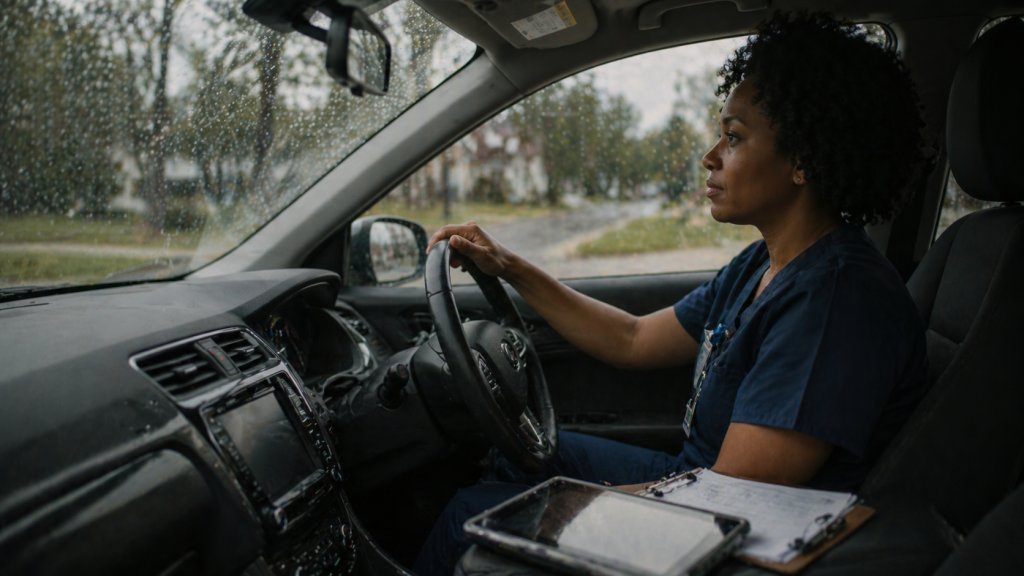
Nurses Week 2026 arrives May 6 with the theme “The Power of Nurses.” Hospitals will host appreciation breakfasts. Health systems will post tribute videos. Executive teams will sign cards.
Meanwhile, somewhere in the country, a home health nurse will pull into an unfamiliar driveway, walk into a house she has never been inside, and treat a patient she has never met, alone.
That is the reality this week is supposed to honor. And it is the reality most appreciation campaigns quietly skip past.
What “The Power of Nurses” Actually Means in Home Health
Hospital nurses work inside controlled environments. They have charge nurses, security teams, code response protocols, and colleagues within shouting distance. When something goes wrong, help is seconds away.
Home health clinicians have none of that. A typical home health nurse performs five to eight solo visits per day in environments the organization cannot inspect, secure, or staff. The patient’s home is the workplace, and every workplace is different.
That difference is not abstract. It shapes everything about how risk shows up in a clinician’s day:
- A caregiver in the home who is intoxicated, hostile, or armed
- A patient experiencing acute psychiatric distress without a support team present
- An unsafe neighborhood where the clinician must walk to and from a parked vehicle after dark
- A medical emergency the clinician must manage alone while waiting for EMS
- A pet, a firearm, or an environmental hazard the agency had no way to anticipate
The power of these nurses is real. It is also unsupported by most of the safety infrastructure their employers provide.
The Data Behind the Disconnect
Healthcare workers experience workplace violence at rates four to five times higher than the average U.S. worker. According to the most recent Bureau of Labor Statistics data on workplace violence in healthcare, healthcare workers accounted for 73% of all nonfatal workplace injuries and illnesses caused by violence, despite making up only about 10% of the workforce.¹
Home health is not a milder version of this problem. It is often the more exposed version.
A 2024 study published in Health Affairs Scholar analyzing a decade of BLS data found that 61% of home health care workers reported experiencing physical assaults from patients, a rate substantially higher than the 44% reported by nurses overall.² Workers in psychiatric facilities and home health settings consistently showed the highest workplace violence rates across all healthcare occupations studied.
The operational consequences are significant:
- Turnover: Home health agencies report annual clinician turnover rates between 40% and 60%, with unsafe working conditions cited as a leading driver.
- Replacement cost: Industry estimates place the cost of replacing a single home health clinician at $3,500 to $7,500 when factoring in recruitment, onboarding, and lost productivity.
- Visit capacity: Each unfilled clinical position represents lost patient visits, deferred care, and pressure on remaining staff who must absorb the workload.
The math is straightforward. An agency with 200 clinicians at 50% turnover is replacing 100 nurses every year. At a conservative $3,500 per replacement, that is $350,000 annually in turnover costs alone, before any consideration of workers’ compensation claims or liability exposure.
Appreciation breakfasts do not move that number. Operational change does.
What Operational Accountability Actually Looks Like
Honoring nurses during Nurses Week is meaningful when it reflects how an organization protects them the other 51 weeks of the year. For home health agencies, that protection has to be built around three principles.
Help has to travel with the clinician
Fixed panic buttons protect buildings. Security guards protect campuses. Neither follows a clinician into a patient’s home. Any safety infrastructure that ends at the agency’s parking lot is incomplete by definition.
Effective clinician protection has to be portable, wearable, and operational in any environment where the clinician is working, including private residential interiors, rural routes between visits, and unfamiliar neighborhoods.
Activation has to be faster than reaching for a phone
When a situation escalates, a clinician does not have time to unlock a phone, find an app, and tap through screens. Many incidents unfold in seconds, and many require the clinician to maintain composure and avoid telegraphing distress to an aggressor.
Real protection requires single-action activation that works whether the phone is in a pocket, a bag, or across the room. It also requires a discreet mode that allows the clinician to call for help without escalating the situation in front of the person causing harm.
Leadership has to have visibility
A safety program without documentation is not a program. It is a hope. Operations and clinical leadership need real-time awareness of when alerts occur, where they occur, how they were resolved, and what patterns they reveal across teams, regions, and patient populations.
That visibility is what makes safety a managed function rather than an aspiration. It is also what allows agencies to demonstrate duty of care to insurers, regulators, and the clinicians themselves.
How Silent Beacon Supports Home Health Clinician Protection
Silent Beacon was built for exactly this operational reality: clinicians working alone, in uncontrolled environments, where help has to be one press away and visibility has to extend back to a centralized team.
Several capabilities map directly to home health workflows:
- Wearable Bluetooth panic button with single-press activation. The device pairs to the clinician’s smartphone and works without requiring her to unlock or interact with the phone during an emergency. One press triggers an alert.
- Two-way calling to any number, including 911. Silent Beacon connects the clinician directly to whoever she needs in the moment: a supervisor, a clinical response team, an internal safety line, or 911. The built-in speaker and microphone allow hands-free communication through the device itself, so the clinician can speak and listen without holding a phone or stepping away from the situation. Most competing systems route alerts only to internal contacts or third-party monitoring centers, adding delay when seconds matter.
- Footsteps Mode. The clinician can share her live location with designated contacts during a route or visit, giving supervisors real-time awareness of where she is and whether she is moving as expected. This is particularly useful for visits in higher-risk areas or at the end of a long day.
- Silent alert mode. When escalating verbally would put the clinician at greater risk, she can trigger an alert covertly. Supervisors and emergency contacts receive the notification with location data without any audible cue inside the home.
- Cloud dashboard for clinical and operations leadership. Real-time monitoring, alert history, user management, and reporting give VP Clinical Operations and risk leaders the visibility required to manage safety as a program rather than react to incidents after the fact.
Deployment does not require facility infrastructure or a separate cellular plan for the device. Agencies can be fully operational, with devices in clinicians’ hands, in under one week.
The Real Measure of Nurses Week
Nurses Week is valuable when it prompts honest reflection on whether the organization’s actions match its words. The theme this year asks what nurses are powered to do. For home health leadership, the answer depends on what happens after the breakfasts end and the social posts archive.
A nurse driving to her sixth visit of the day, into a home she has never seen, should not have to rely on hope as a safety plan. She should have a tool on her body that connects her to her supervisor, her response team, or 911 in a single press, with two-way communication built into the device itself. She should know that her organization is watching, ready to respond, and able to prove it did everything possible to protect her.
That is what operational accountability looks like. That is what makes the power of nurses real.
Explore Clinician Safety for Your Home Health Agency
If your agency is evaluating how to strengthen home health nurse safety beyond policies and training, Silent Beacon can help. Talk to a safety expert about how home health and behavioral health organizations are deploying wearable protection for their mobile clinicians, and what a phased rollout could look like for your team.
References
- U.S. Bureau of Labor Statistics. Workplace Violence in Healthcare, 2018. https://www.bls.gov/iif/factsheets/workplace-violence-healthcare-2018.htm
- Lombardi B, Jensen T, Galloway E, Fraher E. “Trends in workplace violence for health care occupations and facilities over the last 10 years.” Health Affairs Scholar, Volume 2, Issue 12, December 2024. https://doi.org/10.1093/haschl/qxae134