New York Hospital Workplace Violence Law: What Healthcare Leaders Need to Know
Key Takeaways
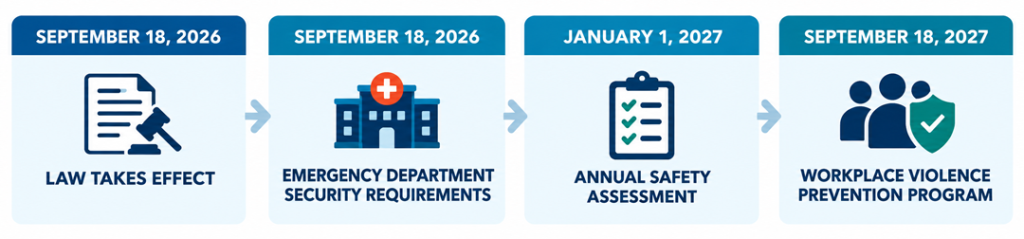
- New York Public Health Law Sections 2832 and 2832-a of the New York Public Health Law take effect September 18, 2026, establishing new workplace violence prevention and emergency department security requirements for covered healthcare facilities. Source
- Beginning September 18, 2026, qualifying general hospitals must meet new emergency department security requirements, including maintaining trained security personnel or an off-duty law enforcement officer in or near the emergency department, subject to certain exceptions. Source
- Beginning January 1, 2027, New York general hospitals must conduct a workplace safety and security assessment at least annually to identify workplace violence threats and hazards and develop a safety and security plan. Source
- By September 18, 2027, covered general hospitals and nursing homes must establish a workplace violence prevention program addressing identified threats and hazards. Source
- The law directs general hospitals to consider controls including alarms, communication systems, safety equipment, staffing, access controls, environmental improvements, security procedures and employee training. Source
New York’s law does not specifically require hospitals to provide wearable panic buttons. Mobile alerting and other employee safety technologies may be considered as part of a broader workplace violence prevention strategy based on the risks identified by each hospital.
What Does Alyssa's Law in Illinois Actually Require?
New York healthcare organizations are entering a new phase of workplace violence prevention.
The New York hospital workplace violence law takes effect September 18, 2026, creating new requirements for violence prevention programs, hospital safety assessments and emergency department security. But the law should not be interpreted as an immediate mandate for hospitals to deploy wearable panic buttons or any other single piece of technology.
Instead, the legislation creates a structured process for hospitals to identify workplace violence risks, evaluate existing protections and determine which combination of staffing, policies, training, physical safeguards, communication systems and safety technology is appropriate for their facilities.
For hospital operations, security, nursing, risk management and workplace safety leaders, the next year represents an important assessment and implementation period.
This article is provided for general informational purposes and does not constitute legal advice. Schools should review applicable state guidance and consult local 911 authorities, legal counsel, and other appropriate officials when determining their obligations under Illinois law.
What Changes on September 18, 2026?
New York Public Health Law Section 2832 of the New York Public Health Law establishes workplace violence prevention requirements for general hospitals and nursing homes.
The law defines a covered facility as a general hospital or nursing home and requires each facility to establish a workplace violence prevention program within 12 months of the law’s September 18, 2026 effective date. For general hospitals, the program must also be consistent with applicable federal patient-safety, emergency preparedness and accreditation requirements.
That creates a major deadline of September 18, 2027.
General hospitals have another important date much sooner.
Beginning January 1, 2027, every general hospital must conduct a workplace safety and security assessment at least annually and develop a safety and security plan addressing identified workplace violence threats or hazards. Employees must be actively involved in the assessment and planning process, including recognized collective bargaining representatives where applicable.
The law does not prescribe one standard safety configuration for every hospital.
Instead, the New York healthcare workplace violence requirements call for an assessment tailored to the size, complexity, geography and specific risks of each general hospital.
What Must Hospitals Consider in the Assessment?
The legislation provides a broad framework for what hospitals should evaluate.
- Workplace violence incident reports and incident logs
- Concerns or complaints from employees, patients and visitors
- Facility layout and access points
- Visitor management
- Access controls
- Engineering controls
- Alarms and communication systems
- Employee training
- Security procedures
- Safety equipment
- Staffing and security
- Facility improvements or modifications
The assessment must also consider how disruptive or violent patients and other individuals are handled.
This is an important distinction for hospital leaders evaluating technology.
The legislation is not asking hospitals to buy a particular device. It is asking them to identify their risks and then determine which controls can reduce those risks.
What About Nursing Homes?
Section 2832 also applies to nursing homes, but the compliance pathway is not identical to the one established for general hospitals.
The annual assessment requirement beginning January 1, 2027 is specifically directed at general hospitals. The law also provides that nursing homes complying with specified federal assessment and emergency planning regulations can satisfy the section’s requirements, provided those assessments and plans address workplace violence threats and hazards.
Organizations operating both hospitals and nursing facilities should therefore evaluate the requirements applicable to each type of facility rather than assuming the same process applies everywhere.
Emergency Department Security Requirements Also Begin September 18
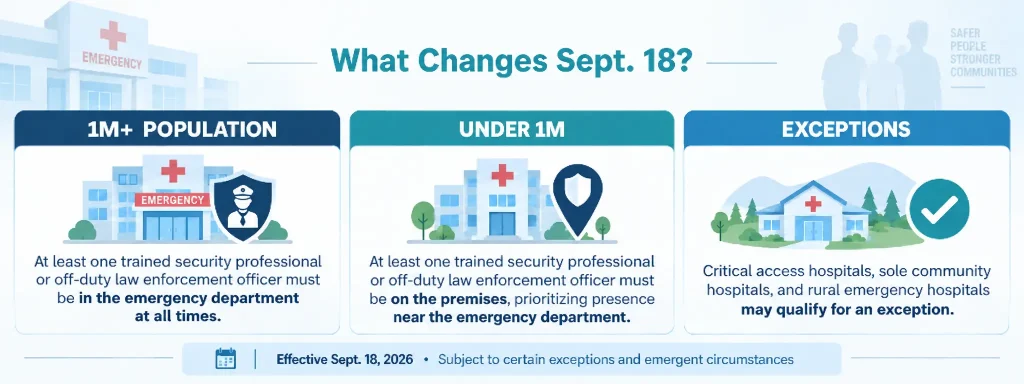
Public Health Law Section 2832-a of the New York Public Health Law creates a separate set of requirements specifically addressing emergency department security.
For a general hospital located in a city or county with a population of one million or more, the law requires at least one off-duty law enforcement officer or trained security professional to be present in the emergency department at all times, subject to emergent circumstances requiring staffing adjustments.
For a general hospital in a city or county with fewer than one million residents, at least one off-duty law enforcement officer or trained security professional must generally be on the premises at all times. The law directs hospitals to prioritize physical presence near or in close proximity to the emergency department, with direct responsibility for that department.
Critical access hospitals, sole community hospitals and rural emergency hospitals receive an exception, although the law provides a process for requiring additional security if increased rates of violence or abuse involving emergency department personnel are documented.
Physical security, however, is only one component of workplace violence prevention.
Hospitals also need to consider what happens when an employee encounters a threat somewhere a security professional is not immediately present.
Workplace Violence Remains a Significant Healthcare Risk
The new legislation addresses a longstanding challenge across healthcare environments.
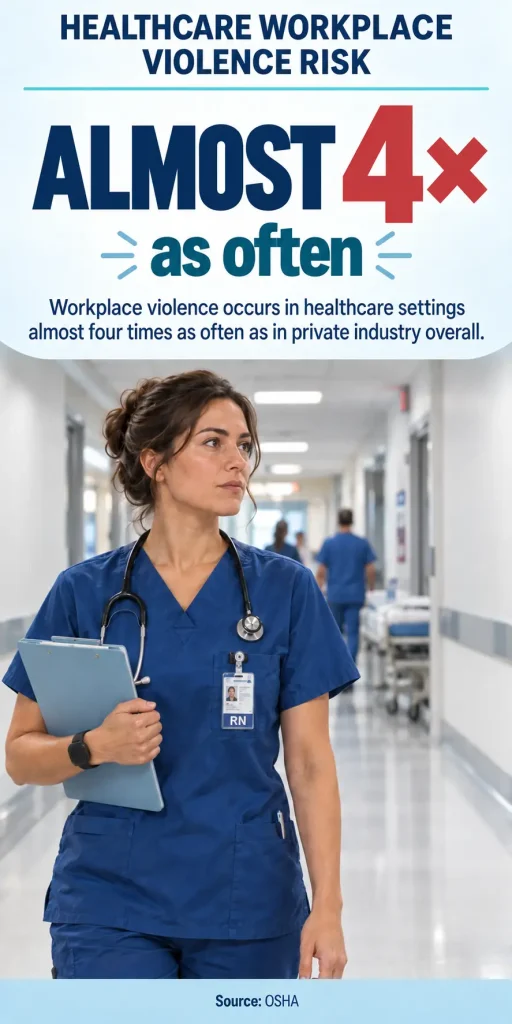
According to OSHA, workplace violence occurs in healthcare settings almost four times as often as in private industry overall. Nurses and aides who have frequent direct contact with patients are among those at elevated risk.
OSHA: Workplace Violence in Healthcare
The risk also differs significantly from one organization to another.
OSHA notes that factors including hospital location, size, the type of care provided, patient population and working conditions can affect workplace violence risk.
That variation helps explain why an individualized assessment is so important.
Violence does not always begin with an obvious emergency. It can develop through threats, intimidation, aggressive behavior, escalating patient encounters or confrontations with visitors.
As hospitals review hospital employee safety technology, they should therefore look beyond the most extreme scenario and evaluate how employees can request assistance across a range of situations.
What Hospitals Should Evaluate Before January 2027
The strongest response to the hospital violence prevention requirements in New York is not to immediately purchase another safety product.
Hospitals should first understand their current response process and identify where it creates gaps.
1. Identify Where Employees Face the Greatest Risk

Incident reports, employee feedback, security records and previous response data can help identify where violent or threatening encounters are occurring.
Hospitals may want to examine areas including:
- Emergency departments
- Behavioral health units
- Patient rooms
- Reception and waiting areas
- Pharmacies
- Parking garages and lots
- Hallways and transitional areas
- Isolated workspaces
- Entrances and outdoor areas
The new law specifically requires consideration of incident information, employee concerns, facility layout, access points and other hospital-specific factors.
2. Map How Employees Currently Request Help

For every higher-risk location, ask one practical question:
What does an employee actually have to do when they need help?
Does the employee need to reach a fixed panic button? Find a phone? Unlock a smartphone? Leave the area? Call an extension? Get another employee’s attention?
Mapping those steps can reveal friction between recognizing a threat and getting information to the appropriate responder.
3. Determine Who Should Receive an Alert

Not every incident requires the same response.
Hospitals should define which situations should notify:
- On-site security
- A supervisor
- A designated response team
- Hospital operations
- Emergency services
- Nearby employees or other designated personnel
Those escalation pathways should be defined as part of the organization’s safety procedures rather than determined only after a technology platform is selected.
4. Evaluate Mobility

Healthcare employees rarely remain in one location for an entire shift.
Nurses, physicians, technicians, environmental services employees, behavioral health professionals and other staff regularly move through patient rooms, corridors, treatment areas, parking facilities and other spaces.
When evaluating healthcare worker safety technology, hospitals should consider whether employees can request help from the places where they actually work.
A fixed solution may be appropriate for some risks. A mobile solution may address others.
The assessment should help determine where each approach fits.
5. Review What Happens After an Alert

Activation is only the beginning of an emergency response process.
Hospitals should evaluate:
- Who receives the notification
- What information the responder receives
- Whether the employee can communicate with the responder
- Whether responders can determine the employee’s location
- How nearby personnel are informed
- How the incident is documented
- How response performance is reviewed afterward
Section 2832 specifically connects incident reporting and incident-log analysis with the ongoing workplace violence assessment process.
Where Mobile Safety Technology Can Fit
After hospitals understand their risks and existing response pathways, they can evaluate whether additional alarms, communication systems or safety equipment could address identified gaps.
This is where a mobile safety solution such as Silent Beacon can become part of the conversation.
Silent Beacon 2.0 is a wearable safety device that connects through a paired smartphone. An emergency activation can place a call through that smartphone to a preconfigured number selected by the organization, such as 911, an internal security team, supervisor, dispatcher or monitoring service.
Several capabilities may be relevant when hospitals evaluate workplace violence response workflows.
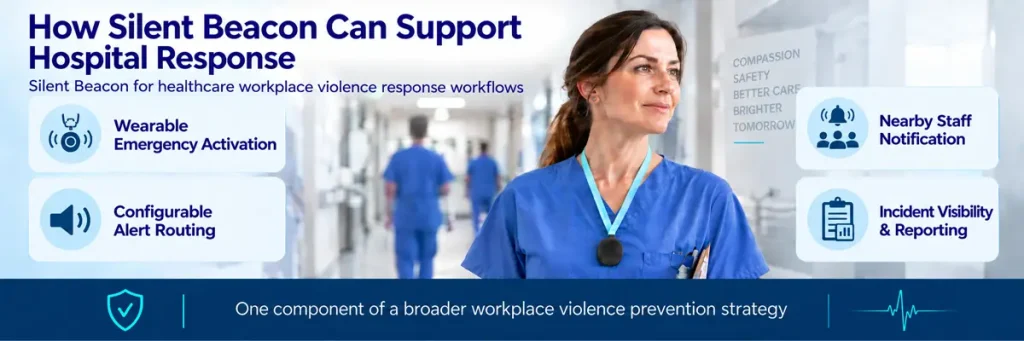
Configurable Emergency Routing
Hospitals can configure where an emergency call is directed based on their existing escalation strategy rather than relying on one fixed response destination. That flexibility may be useful for organizations where different teams or facilities use different response procedures.
Hands-Free Communication
Hospitals can configure where an emergency call is directed based on their existing escalation strategy rather than relying on one fixed response destination. That flexibility may be useful for organizations where different teams or facilities use different response procedures.
Silent Mode
During an emergency alert, Silent Mode can disable the Beacon's speaker and LED while the microphone and alert transmission remain active. That provides an option for situations where an employee may need to call for assistance without drawing additional attention to the activation.
Location Sharing During Alerts
When an alert is active, Silent Beacon can share the employee's GPS location with designated members of the alert group through the paired smartphone. Location is shared during the active alert rather than through continuous passive tracking. Location information can be particularly relevant in large facilities or environments where employees regularly move between work areas.
These capabilities should be evaluated as potential parts of a broader workplace violence prevention strategy that can also include staffing, physical security, environmental controls, access management, training and established response procedures.
Silent Beacon does not by itself establish compliance with Public Health Law Section 2832 of the New York Public Health Law, and New York has not designated Silent Beacon or any other wearable panic button as required technology.
The Next Year Should Be Used for Planning
The implementation timeline gives New York hospitals an opportunity to look closely at how workplace violence prevention works in practice.
Instead of beginning with the question, “Do we need panic buttons?” healthcare leaders can begin with more useful questions:
- Where are our employees most vulnerable?
- How do employees currently request help?
- How many steps does that process require?
- Can an employee request assistance while moving throughout the facility?
- Who receives the alert?
- Can responders determine who needs help and where they are?
- Can the employee communicate with responders?
- How are incidents documented and reviewed?
- Do employees understand the complete response process?
Those questions can help hospitals identify where policies, staffing, training, physical controls and technology need to work together.
They also align more closely with the risk-based approach established by the new legislation.
Preparing for the New Requirements
The New York hospital workplace violence law establishes several important dates, but effective preparation involves more than meeting a deadline.
Hospitals that begin reviewing incident data, employee concerns, communication pathways, security procedures and safety technology now will be better positioned when annual assessments begin January 1, 2027 and workplace violence prevention programs must be established by September 18, 2027.
For organizations evaluating how mobile alerting could fit into that broader strategy, explore how Silent Beacon supports healthcare teams or talk to a safety expert about your current employee response process.