Behavioral Health Workplace Violence Prevention for Community-Based Teams

Key Takeaways
- Effective behavioral health workplace violence prevention starts by planning for the clinician who has no backup in the room: a documented risk assessment that includes frontline staff, a reliable way to summon help without escalating the interaction, and a record of every incident, including the ones that did not result in injury.
- In a survey of 1,267 registered nurses conducted between July 2025 and May 2026, fewer than one in five said their employer includes frontline staff in violence risk assessments, and only about four in ten said there was a clear way to report an incident.
- Health care and social assistance carries the highest workplace violence rate of any private industry sector at 14.2 DART cases per 10,000 full-time workers, against a private-industry average of 2.9.
- Most prevention programs are built around inpatient settings, where help is down the hall. Community-based and mobile crisis clinicians face comparable volatility with none of that proximity.
- An alert that announces itself can escalate the exact situation a clinician is trying to calm. Discretion is a clinical requirement in behavioral health, not a preference.
The most important thing a behavioral health organization can do about workplace violence is design its prevention program around the clinician who is alone, because that is where the gap actually sits. Inpatient staff have colleagues within earshot. A mobile crisis worker in a client’s living room, or an outpatient clinician in a late-afternoon session at the end of an empty hallway, does not.
The Moments That Turn Are Rarely the Ones Flagged in Advance
Ask any experienced behavioral health clinician about a situation that escalated and you will usually hear about a routine appointment. Not the client with the documented history. Not the assessment that came in flagged. A regular visit, with someone who was managing well last month, who stopped a medication or lost housing.
This is what makes behavioral health different from other high-risk work. The risk is not attached to a location you can secure or a time of day you can staff differently. It moves with the client’s circumstances, and it often arrives with no warning that a chart review would have caught.
Clinicians already know this, which is why they develop their own informal practices. Sitting nearer the door. Texting a colleague before a particular visit. Moving an appointment to the morning. These habits are real risk management, and they are almost never written down anywhere the organization can see them. So the clinician carries the risk alone, and the organization has no record that it exists.
SIT NEAR THE DOOR
TEXT A COLLEAGUE
MOVE THE APPOINTMENT
Informal safety habits are real risk management. The problem is that the organization often cannot see them.
What the Data Shows
The most useful recent finding is not about how often violence happens. It is about how little of it the organization can see.
National Nurses United surveyed 1,267 registered nurses across 28 states and D.C. between July 2025 and May 2026. Fewer than one in five said their employer includes frontline staff in violence risk assessments. Only about four in ten said there was a clear way to report an incident when one occurred.
Read those together. If most incidents have no straightforward reporting path, the risk assessment is being written from a record that is already incomplete, by people who were not in the room. Two gaps compounding.
The survey covers nursing rather than behavioral health specifically, and NNU is a labor union, so take it as what it is. But the pattern will be familiar to anyone who has sat in a behavioral health quality meeting.
Federal data fills in the structural picture. The Bureau of Labor Statistics puts health care and social assistance at 14.2 DART cases per 10,000 full-time workers, the highest annualized rate of any private industry sector, against a private-industry average of 2.9. DART means days away, restricted duty, or job transfer, so these are injuries serious enough to change someone’s ability to work. Within that sector, psychiatric aides recorded by far the highest occupational rate of any detailed service occupation.
Two caveats worth stating plainly, because they get mishandled elsewhere. BLS publishes this data every two years, so the current workplace violence factsheet covers 2021 to 2022. And the psychiatric aide figure is weighted toward inpatient settings, where most psychiatric aides work.
That second point is where the real question sits. The driver behind the number, sustained close contact with people in acute distress, does not stop at the facility door. It travels to the mobile crisis call, the community outreach visit, and the late outpatient appointment. What does not travel is the response. Inpatient staff have colleagues within shouting distance and a protocol that activates in seconds. A community-based clinician has a phone in a bag and whoever happens to answer.
Frontline staff included in violence risk assessments
Have a clear way to report an incident
Building Prevention Around the Clinician Who Is Alone
Four principles, none of which require new technology to start.
Put frontline clinicians in the risk assessment
Your clinicians can already name the addresses that make them uneasy and the client situations that have changed recently. None of that reaches a risk assessment written in a conference room. Bring two or three clinicians from each program into the assessment itself, not as reviewers of a finished draft. It is the cheapest improvement available.
Make reporting take less than a minute
When reporting means a form, a supervisor conversation, and a follow-up, clinicians triage it against a full caseload and the near-misses never get logged. Those near-misses are the most useful data an organization has, because they describe risk before someone is hurt. If a verbal threat during a home visit cannot be logged in under a minute from a phone in a car, it will not be logged.
Treat discretion as a clinical requirement
This is where behavioral health departs sharply from other industries. In a warehouse, a loud alarm is a reasonable response to a safety event. In a behavioral health interaction, a visible or audible alarm can escalate the precise situation the clinician is working to de-escalate.
Any mechanism for summoning help has to work without announcing itself to the person in the room. If it does not, clinicians will not use it, and a safety tool nobody uses is a line item, not a control.
Define what happens after the alert
Most programs stop at the alert. Who receives it, how fast they respond, what they are authorized to do, and what gets recorded afterward determine whether anything useful happens. Write the answer down for each program, then test it. A protocol nobody has rehearsed is a document, not a response.
How Silent Beacon Fits Into a Behavioral Health Safety Program
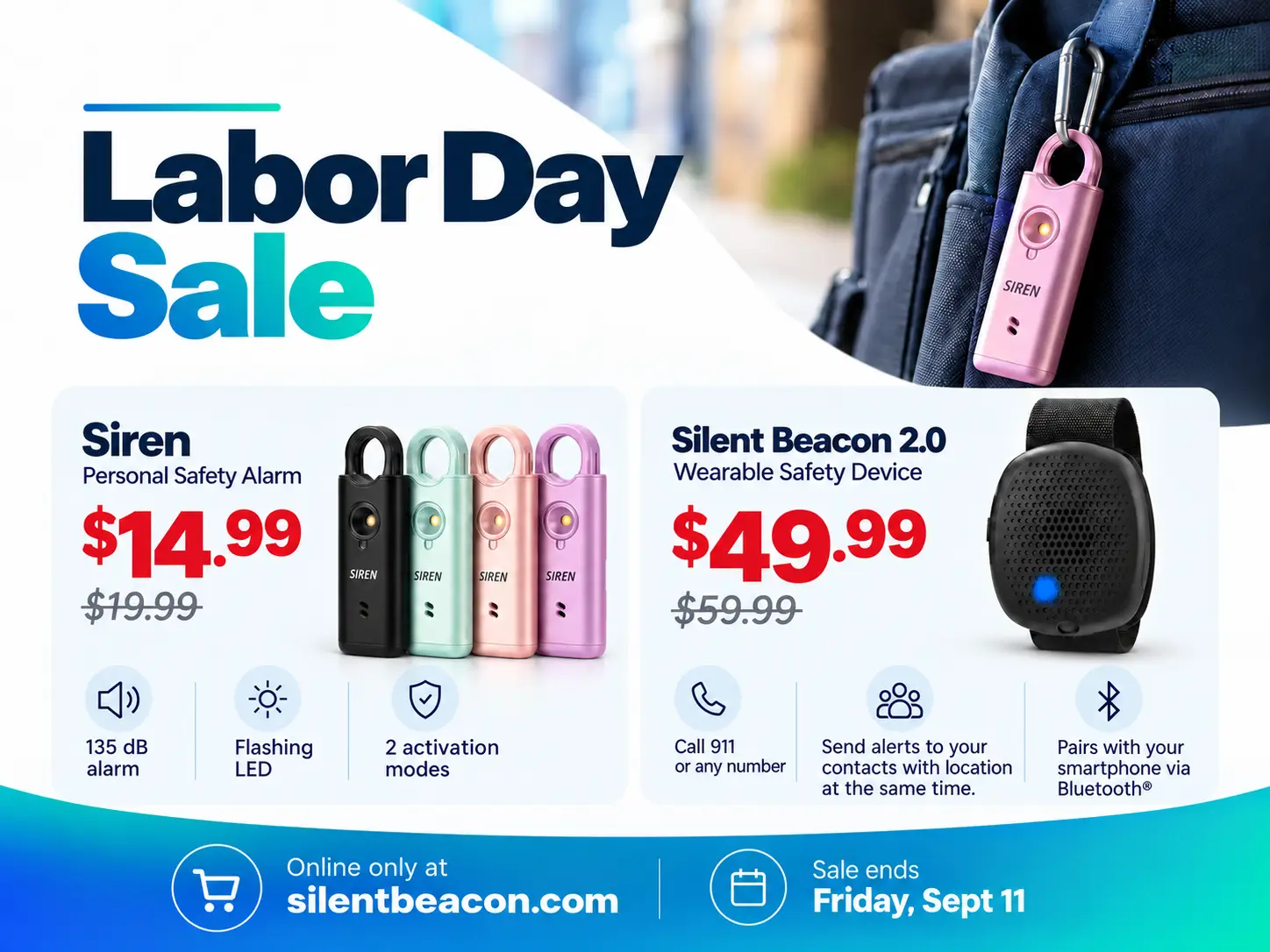
Silent Beacon was built for exactly the gap described above: the worker who is away from the building, often alone, who needs to call for help without creating a scene. Silent Beacon’s 2.0 panic button pairs to the clinician’s phone over Bluetooth® and wears on a lanyard, a bag strap, or a belt clip, so summoning help does not mean retrieving and unlocking a phone mid-interaction.
Four capabilities map directly to the principles above:
- Silent Mode addresses the escalation problem. The speaker and LED can be suppressed, so activation is not visible or audible to anyone else in the room. The clinician gets help on the way without changing the dynamic in front of them.
- Multi-channel alerting defines who responds. When activated, the device places a hands-free call through the paired phone while simultaneously sending a text, an email, and a push notification with GPS location to the contacts the organization designates. There is no question of who was notified.
- The Control Center creates the record. Alerts are logged centrally with time and location, which gives the organization the incident history that a risk assessment depends on, and that a state workplace violence prevention requirement will eventually ask for.
- Check-In Mode covers the routine visit. Clinicians can send a safe-arrival or safe-departure message with location, which turns the informal “text me when you’re done” habit into something the program can actually see.
One practical note worth being straightforward about. The 2.0 pairs over Bluetooth and uses the clinician’s phone for cellular or wifi connectivity, so it works wherever your teams already have normal phone service. That covers home visits, outpatient sites, community locations, and vehicles. It is not a satellite device, so it is not the right tool for genuinely remote work with no coverage.
For organizations evaluating a program across multiple sites, the healthcare safety page covers deployment and administration in more detail.
Frequently Asked Questions.
What is the biggest gap in behavioral health workplace violence prevention programs?
Programs are usually designed around inpatient settings, where help is physically nearby. Community-based clinicians, mobile crisis teams, and outpatient staff working late face similar volatility without that proximity, and prevention measures built for a facility do not transfer to a client’s living room.
Why does a silent alert matter in behavioral health specifically?
Because a visible or audible alarm can escalate the situation the clinician is actively de-escalating. In most industries a loud alarm is an appropriate response. In behavioral health it can make the moment worse, which is why discretion is a clinical requirement rather than a feature preference.
How dangerous is behavioral health work compared with other occupations?
Bureau of Labor Statistics data puts health care and social assistance at 14.2 DART cases per 10,000 full-time workers, the highest annualized rate of any private industry sector and well above the private-industry average of 2.9. Within that sector, psychiatric aides record the highest rate of any detailed service occupation. BLS publishes this data biennially, and the current workplace violence factsheet covers 2021 to 2022.
What should we document about workplace violence incidents?
Log the incidents that did not cause injury as well as the ones that did. Near-misses and verbal threats describe where risk is building, and they are the data that makes a risk assessment credible. If logging an incident takes longer than a minute from a phone, it will not happen consistently.
Do staff have to carry another device?
The Silent Beacon 2.0 is a small wearable panic button that pairs to the phone your clinicians already carry. It does not require its own cellular plan, but it does rely on the paired phone having service.
Can silent response buttons track employees?
The amended law includes employee privacy protections that prohibit wearable and mobile-based silent response buttons from tracking employee locations unless an alert has been activated.
What training is required under the Retail Worker Safety Act?
Covered retailers must provide interactive workplace violence prevention training that includes de-escalation tactics, emergency procedures, active shooter response, and instruction on emergency devices and security alarms. Training frequency depends on employer size.
Do small retailers need to comply with the law?
Yes. Retailers with at least 10 retail employees in New York must comply with the workplace violence prevention portions of the law. However, the silent response button requirement only applies to retailers with 500 or more retail employees statewide.
Protecting Clinicians Who Work Beyond the Building
Mental Illness Awareness Week is a reasonable moment to ask a direct question about your own organization: if a clinician needed help during a home visit this afternoon, what would actually happen, and where would it be recorded?
If the honest answer involves a phone call to a main line and nothing written down afterward, that is the gap worth closing first.
Talk to a safety expert about protecting your clinical teams and we will walk through what deployment looks like across your programs.