What Retailers Need to Know About the New York Retail Worker Safety Act

The New York Retail Worker Safety Act has been in effect since June 2, 2025. Most New York retailers with 10 or more employees are already required to have a workplace violence prevention policy, employee training, risk assessments, and incident response procedures in place. The next deadline is the one still ahead: starting January 1, 2027, retailers with 500 or more employees statewide must also give workers access to silent response buttons.
If your organization is not yet compliant with the 2025 requirements, that is current exposure, not future planning. And for larger retailers, the 2027 silent response button requirement is now months away. For many retailers this is not a simple policy update; it is an operational and compliance shift focused on workplace violence prevention, employee protection, and emergency response readiness.
New York Retail Worker Safety Act Requirements
- Applies to New York retailers with 10+ retail employees
- Compliance requirements in effect since June 2, 2025
- Retailers must implement workplace violence prevention programs
- Employers with 500+ retail employees statewide must provide silent response buttons by January 1, 2027
- The law requires interactive employee training and documented workplace violence policies
- Mobile and wearable silent response buttons are permitted under the law
- Employers cannot use wearable or mobile button systems to track employee locations unless an alert is activated1
Retail organizations should begin evaluating workplace violence prevention procedures, employee training workflows, and emergency response readiness before compliance deadlines arrive.
What Is the New York Retail Worker Safety Act?
The New York Retail Worker Safety Act is a workplace violence prevention law designed to improve employee safety in retail environments. The law requires covered employers to create formal workplace violence prevention programs and establish emergency response procedures for retail workers.
The legislation was signed into law in 2024 and later amended in 2025 to revise several requirements, including the original panic button language.2
The law focuses on operational risks commonly found in retail environments, including:
- Working alone or in small numbers
- Late-night or early-morning shifts
- Cash handling
- Uncontrolled public access
- Aggressive customer interactions
- Workplace violence incidents and threats
According to the U.S. Bureau of Labor Statistics, workplace assaults remain one of the leading causes of occupational injuries in customer-facing industries, particularly retail and healthcare.3
Who Must Comply With the New York Retail Worker Safety Act?
The law applies to retail employers with at least 10 retail employees in New York State1.
The law defines a retail store as a business that sells consumer commodities directly to the public and is not primarily engaged in food service for on-site consumption.
Examples of covered businesses include:
- Big box retailers
- Convenience stores
- Drug stores
- Sporting goods stores
- Beauty retailers
- Factory outlets
- Gas stations
The law does not only apply to large national chains. Regional and multi-location retailers can also fall within the coverage threshold.
When Does the Law Take Effect?
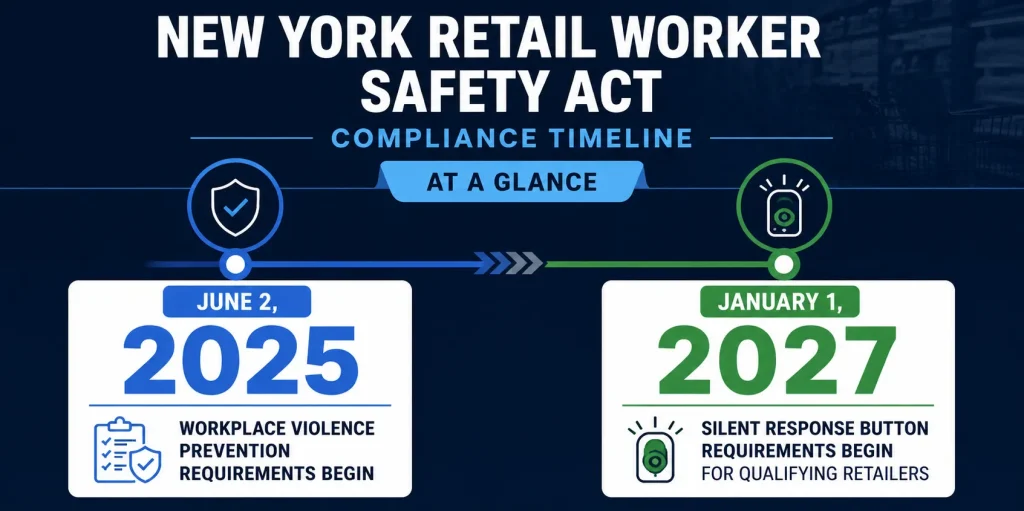
| Deadline | Requirement |
| June 2, 2025 | Workplace violence prevention requirements begin |
| January 1, 2027 | Silent response button requirements begin for qualifying employers |
What Does the Retail Worker Safety Act Require Retailers to Do?
The law requires retailers to implement a workplace violence prevention framework, not just emergency buttons.
Covered employers must address several operational and compliance requirements.
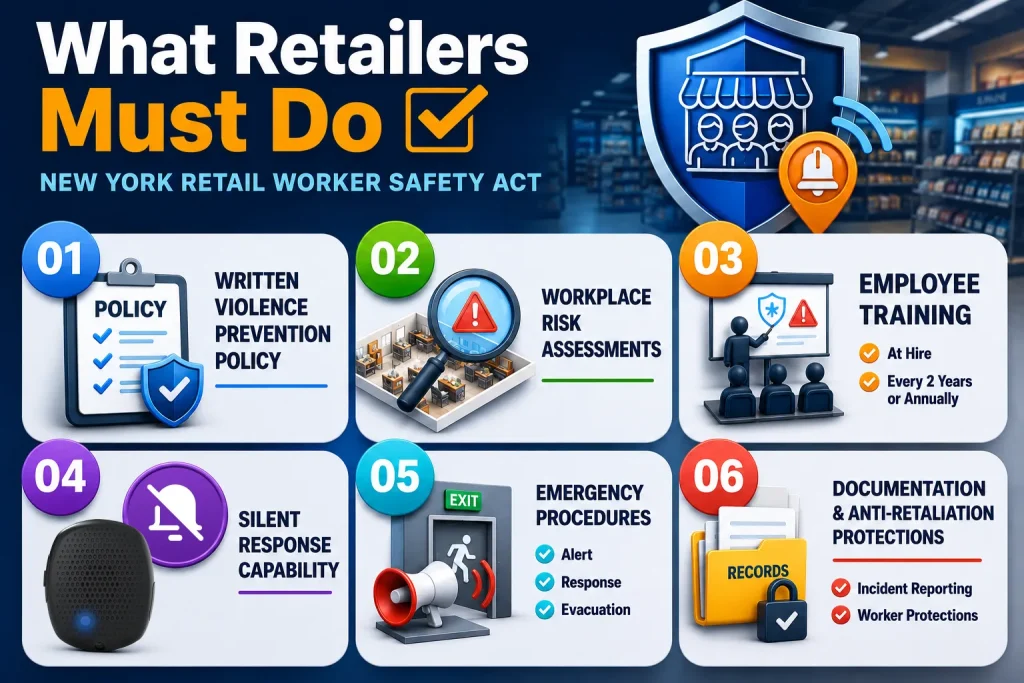
Retailers Must Create a Workplace Violence Prevention Policy
Retail employers must adopt either the New York Department of Labor’s model workplace violence prevention policy or a policy that meets or exceeds state requirements.1
- The New York Department of Labor’s model workplace violence prevention policy
- Or a policy that meets or exceeds the state’s minimum standards
The written policy must address:
- Workplace violence risk factors
- Incident reporting procedures
- Prevention methods
- Legal protections for workers
- Anti-retaliation protections
Employees must receive the policy:
- At hire
- Annually thereafter
- In writing
- In English and, where applicable, the employee’s primary language
For retailers operating multiple locations, maintaining consistent documentation and distribution processes will likely become a major compliance priority.
Retailers Must Conduct Workplace Violence Risk Assessments
- Late-night operations
- Cash transactions
- Employees working alone
- Open public access areas
- Staffing patterns
- Store layouts
- Emergency communication gaps
- Escalation procedures
- Existing alarm systems
- Lone worker exposure
Employee Training Is Mandatory
- De-escalation tactics
- Emergency procedures
- Active shooter response
- Workplace violence prevention measures
- Security alarm and emergency device usage
- Emergency exits and meeting locations
| Retail Employee Count | Training Frequency |
|---|---|
| 10–49 Employees | At hire and every two years thereafter |
| 50+ Employees | At hire and annually thereafter |
Important Amendment Update
The original version of the Retail Worker Safety Act referenced direct-to-911 panic buttons. However, the 2025 amendment revised this language and now requires qualifying retailers to provide employees with access to “silent response buttons.”2
This distinction matters because many retailers still mistakenly believe the law requires direct emergency dispatch systems. The amended law focuses on internal emergency response workflows and workplace violence prevention procedures.
Does the Law Require Panic Buttons?
Not exactly.
This is one of the most misunderstood parts of the New York Retail Worker Safety Act.
The original version of the Retail Worker Safety Act referenced direct-to-911 panic buttons. However, the 2025 amendment revised this language and now requires qualifying retailers to provide employees with access to “silent response buttons.”2
Starting January 1, 2027, retailers with 500 or more retail employees statewide must provide employees with access to silent response buttons.1
- A manager
- A supervisor
- Or a security officer
The updated law no longer explicitly requires direct-to-911 emergency dispatch.
Which Retailers Need Silent Response Buttons?
- Fixed-location buttons
- Wearable buttons
- Mobile-based systems
- Large floor plans
- Distributed teams
- Mobile employees
- Multiple store formats
- High-risk customer interaction environments
Evaluating Silent Response Systems for Retail Teams?
Retailers preparing for the New York Retail Worker Safety Act are evaluating wearable and mobile-based silent response systems that support faster emergency escalation, frontline employee safety, and multi-location deployment.
Silent Beacon helps organizations implement discreet emergency response workflows designed for real-world retail operations.
The Law Includes Employee Privacy Restrictions
The amendment added an important employee privacy provision. Wearable and mobile-based silent response buttons cannot track employee locations unless an alert has been activated.1
For many organizations, balancing employee privacy expectations with emergency response visibility will become a critical part of implementation planning.
Retailers evaluating workplace violence prevention systems may need to consider:
- employee trust
- privacy protections
- operational oversight
- and emergency response workflows
Why Retailers Are Paying Attention to This Law
The New York Retail Worker Safety Act reflects a broader national shift toward workplace violence prevention requirements. Retail organizations are facing increasing pressure from:
- employee safety concerns
- labor expectations
- litigation exposure
- union scrutiny
- operational liability
- and public workplace violence incidents
For enterprise retailers, compliance is only part of the challenge.
- multiple locations
- varying store formats
- rotating staff
- and inconsistent security infrastructure
How Retailers Can Operationalize Compliance
Many retailers are now evaluating how to move from policy compliance to real-time emergency response readiness.
A practical workplace violence prevention strategy often includes:
1. Clear Incident Escalation Procedures
Employees should clearly understand:
- when situations should be escalated
- how to request immediate assistance
- who receives emergency alerts
- and what response steps occur after an incident is reported
2. Accessible Emergency Communication Tools
Emergency systems should be:
- discreet
- easy to activate
- reliable during high-stress situations
- accessible without requiring employees to unlock or reach for a phone
3. Multi-Location Consistency
Retailers with distributed operations need standardized:
- training
- reporting
- response workflows
- and compliance documentation
4. Employee Adoption and Ease of Use
Emergency response systems are only effective if employees can use them quickly and confidently during stressful situations.
Retailers evaluating workplace violence prevention tools should consider:
- ease of activation
- accessibility during active incidents
- employee training requirements
- response speed
- and how seamlessly the system fits into everyday retail workflows
Where Silent Beacon Fits Into Retail Workplace Violence Prevention
For retailers evaluating workplace violence prevention technology, the challenge is often balancing:
- compliance
- usability
- emergency response speed
- workforce adoption
- and operational simplicity
Silent Beacon helps retail organizations implement discreet emergency response workflows designed for frontline employee safety and workplace violence prevention.
Key capabilities include:
- wearable and mobile-based emergency activation
- silent emergency alerts
- multi-channel notifications
- cloud-based management and reporting
- and rapid deployment without dedicated infrastructure
Unlike traditional emergency systems, employees can activate alerts without unlocking or reaching for their phone. This can be especially important during high-pressure retail incidents where speed and discretion matter.
The platform can notify supervisors, response teams, designated contacts, or emergency services based on organizational response workflows.
For retailers evaluating privacy concerns under the New York Retail Worker Safety Act, Silent Beacon’s location visibility activates only during active alerts, aligning closely with the law’s employee tracking restrictions.
The platform is designed to support:
- multi-location retail organizations
- distributed workforce environments
- regional management teams
- and scalable workplace violence prevention programs
Key Takeaways
- The New York Retail Worker Safety Act goes beyond policy documentation and requires operational workplace violence prevention planning.
- Retailers with distributed operations may need standardized emergency response workflows, employee training, and incident escalation procedures.
- Silent response button requirements beginning in 2027 will likely accelerate evaluation of wearable and mobile-based emergency response systems.
- Employee privacy protections may influence how retailers evaluate workplace safety technology vendors.
- Organizations should begin assessing implementation readiness before compliance deadlines arrive.
Retail organizations should begin evaluating workplace violence prevention procedures, employee training workflows, and emergency response readiness before compliance deadlines arrive.
Organizations evaluating workplace violence prevention strategies should focus not only on compliance, but also on creating practical, scalable safety processes employees can actually use during emergencies.
Evaluating Silent Response Systems for Retail Teams?
See how Silent Beacon supports workplace violence prevention and emergency response readiness across frontline work environments.
Sources ﹠ Regulatory References
- New York Department of Labor Retail Worker Safety Page https://dol.ny.gov/retail-worker-safety
- New York Senate Bill S8358-C / S740 Amendments https://www.nysenate.gov/legislation/bills/2025/S740
- U.S. Bureau of Labor Statistics Workplace Violence Data https://www.bls.gov/
- New York Department of Labor Retail Workplace Violence Prevention Training https://dol.ny.gov/retail-workplace-violence-prevention-training
Frequently Asked Questions.
Does New York require panic buttons in retail stores?
Not exactly. The amended New York Retail Worker Safety Act requires qualifying retailers with 500 or more retail employees statewide to provide employees with access to silent response buttons beginning January 1, 2027. The original version of the law referenced direct-to-911 panic buttons, but the amended law focuses on silent emergency assistance requests to managers, supervisors, or security personnel.
What is a silent response button?
A silent response button is an emergency alert device that allows retail employees to discreetly request immediate assistance during a threatening or dangerous situation. Under the New York Retail Worker Safety Act, silent response buttons may be fixed-location devices, wearable buttons, or mobile-based systems.
When does the Retail Worker Safety Act take effect?
The workplace violence prevention requirements under the New York Retail Worker Safety Act take effect on June 2, 2025. The silent response button requirement for qualifying retailers takes effect on January 1, 2027.
Who must comply with the New York Retail Worker Safety Act?
The law applies to retail employers with at least 10 retail employees in New York State. Retailers with 500 or more retail employees statewide must also comply with the silent response button requirement beginning in 2027.
Are wearable panic buttons allowed under the law?
Yes. The law specifically allows wearable silent response buttons, mobile-based systems, and fixed-location emergency buttons. This flexibility allows retailers to choose emergency response systems that best fit their store layouts and workforce operations.
Can silent response buttons track employees?
The amended law includes employee privacy protections that prohibit wearable and mobile-based silent response buttons from tracking employee locations unless an alert has been activated.
What training is required under the Retail Worker Safety Act?
Covered retailers must provide interactive workplace violence prevention training that includes de-escalation tactics, emergency procedures, active shooter response, and instruction on emergency devices and security alarms. Training frequency depends on employer size.
Do small retailers need to comply with the law?
Yes. Retailers with at least 10 retail employees in New York must comply with the workplace violence prevention portions of the law. However, the silent response button requirement only applies to retailers with 500 or more retail employees statewide.