A Panic Button for Behavioral Health Clinicians: Protecting Your Team During Crisis Care and Home Visits

Behavioral health clinicians face some of the highest rates of workplace violence in U.S. healthcare, and the most practical protection for staff who manage crises or visit clients at home is a discreet, wearable panic button that summons help fast. This guide explains why mental health providers are adding wearable panic devices to their safety programs, what to look for, and how to protect clinicians without disrupting the therapeutic relationship, a question that comes into sharp focus each July during National Minority Mental Health Awareness Month, when the field reflects on sustaining the workforce that serves high-need communities.
The reality behavioral health teams live with
A behavioral health clinician’s job is to stay present during the exact moments most workers are trained to avoid: escalation, acute crisis, and unpredictable emotional volatility. That is the work, not an exception to it. Whether the setting is an inpatient psychiatric unit, an outpatient clinic, a mobile crisis response, or a client’s home, the clinician is often the only person in the room, with both hands and full attention committed to the person in front of them.
That leaves a gap. When an interaction turns, the clinician usually cannot stop, step away, find a phone, unlock it, dial, and explain a location, all while continuing to manage the person in crisis. Fixed alarm buttons mounted on a wall help only if the clinician can reach the wall. Front-desk security cannot follow a clinician into a session or a living room. The result is a workforce that is exposed precisely when it is doing its most important work.
For organizations serving minority and underserved communities, the stakes compound. These programs frequently rely on community-based and in-home visits to reach people who would otherwise go without care. Protecting that workforce is inseparable from protecting access to care itself, which is the throughline of National Minority Mental Health Awareness Month, recognized each July by Mental Health America and partner organizations.
What the data shows
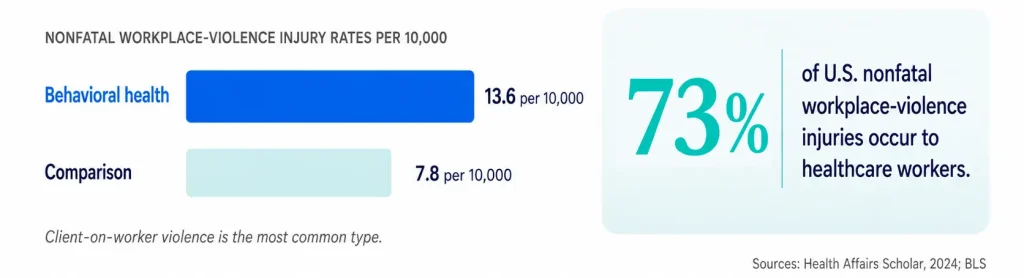
Behavioral health risk is not anecdotal. According to a 2024 analysis published in Health Affairs Scholar, healthcare workers experienced 73% of all nonfatal workplace injuries due to violence in the United States, and intentional violence toward healthcare workers rose 63% between 2011 and 2018. The same analysis, drawing on U.S. Bureau of Labor Statistics data, found that healthcare support occupations experienced 13.6 workplace-violence events per 10,000 workers, compared with 7.8 for healthcare practitioners. Direct-care and support roles, which are heavily represented in psychiatric and behavioral health settings, sit at the higher end of that range.
The most common form of workplace violence in healthcare is client-on-worker violence, the analysis notes, which is the category behavioral health staff encounter as a routine feature of acute care. The U.S. Bureau of Labor Statistics Survey of Occupational Injuries and Illnesses consistently shows healthcare and social assistance as the sector with the highest burden of nonfatal workplace violence.
The downstream cost is workforce loss. The National Nurses United 2025 to 2026 Workplace Violence Survey found that 63.1% of nurses reported anxiety, fear, or increased vigilance tied to workplace violence, and 25.5%, about one in four, considered leaving the profession because of it. For behavioral health leaders already fighting vacancies and burnout, an unaddressed safety problem becomes a staffing problem.
A framework for protecting clinicians
A credible clinician safety program does not rely on any single control. It layers several, and it treats the moment of an incident as something to be survived quickly, not just reported later.
- Assess risk by role and setting. A mobile crisis worker, an inpatient psych tech, and an outpatient therapist face different threat profiles. Map who is alone, where, and when.
- Invest in de-escalation and clinical training. The first and best tool is a clinician’s ability to read and defuse a situation. Technology supports that work; it never replaces it.
- Fix the environment where you can. Clear sightlines, exit access, and waiting-room design reduce avoidable triggers in fixed settings.
- Close the communication gap. Give every clinician a fast, reliable, discreet way to call for help that works in the moment, in a session or a home, without escalating the situation.
- Document consistently. Centralized records of incidents and alerts support pattern analysis, staffing decisions, and the written workplace-violence-prevention plans that a growing number of states now expect.
The fourth point is where most programs have the weakest coverage. Training and environmental controls are common; a dependable, on-person way to summon help during an incident often is not.
How Silent Beacon fits a behavioral health safety program
Silent Beacon is a mobile workforce safety platform used by more than 136,000 people across healthcare and other sectors. Silent Beacon’s 2.0 panic button is a wearable Bluetooth device that pairs to the clinician’s smartphone and uses the phone’s existing cellular or wifi signal to place the call and send alerts, so it needs no separate plan or infrastructure of its own, though it does depend on that paired phone having signal where the clinician is working. For behavioral health teams, a few capabilities map directly to the gaps above.
- Fast, discreet activation. Worn as a clip or lanyard, the panic button is activated without the clinician having to find, unlock, or tap a phone mid-interaction, so their hands and attention can stay on the person in front of them.
- Silent alert mode. A discreet alert can be sent without an audible alarm, which matters during a tense interaction where a loud signal could escalate the situation rather than calm it.
- Check-In Mode for home and community visits. Clinicians doing in-home or field-based work can send a safe-arrival or departure message with location, giving supervisors visibility into visits without continuous tracking.
- Privacy-first design. Location is shared only during an active alert, not throughout the day. That distinction is often what makes staff and unions comfortable adopting a safety device rather than resisting it as surveillance.
When activated, the Silent Beacon 2.0 can place a direct call for help while simultaneously sending text, email, and push alerts with the clinician’s location to designated responders, with optional 24 by 7 professional monitoring. The platform’s cloud dashboard keeps a record of alerts, which supports the documentation and pattern review that workplace-violence-prevention planning increasingly requires.
Frequently Asked Questions.
Why do behavioral health workers need a panic button if they have de-escalation training
De-escalation is the primary defense and works in most situations. A panic button is for the minority of moments when an interaction turns despite a clinician’s best efforts. The two are complementary: training prevents incidents, and a fast, discreet alert protects the clinician when prevention is not enough.
Will a panic alarm escalate a crisis situation?
It does not have to. A silent alert mode lets a clinician summon help without an audible alarm or visible phone use, so the person in crisis is not provoked by a loud or obvious signal. The clinician keeps de-escalating while help is already on the way.
How does a wearable panic button work during a home or community visit?
The wearable pairs to the clinician’s phone and uses the phone’s cellular or wifi signal, so it works in homes, clinics, and community settings with normal coverage. Activating it places a call and sends location-tagged alerts at the same time. A check-in feature can also confirm safe arrival and departure for solo visits.
Does location tracking raise privacy concerns for our staff?
With a privacy-first design, location is shared only during an active alert, not continuously. Clinicians are not tracked through their day, which addresses the main objection staff and unions raise about safety wearables.
How quickly can an organization deploy this across a clinical team?
Because the device relies on the clinician’s existing smartphone and needs no facility wiring or new infrastructure, a rollout can typically be completed in under a week.
Can silent response buttons track employees?
The amended law includes employee privacy protections that prohibit wearable and mobile-based silent response buttons from tracking employee locations unless an alert has been activated.
What training is required under the Retail Worker Safety Act?
Covered retailers must provide interactive workplace violence prevention training that includes de-escalation tactics, emergency procedures, active shooter response, and instruction on emergency devices and security alarms. Training frequency depends on employer size.
Do small retailers need to comply with the law?
Yes. Retailers with at least 10 retail employees in New York must comply with the workplace violence prevention portions of the law. However, the silent response button requirement only applies to retailers with 500 or more retail employees statewide.
Protecting the people who provide care is how organizations sustain access to care. See how behavioral health and mental health providers are equipping clinicians for crisis interactions and field visits on the Silent Beacon business safety solutions page, or talk to a safety expert about a program for your team.