Text to 911 Is Evolving. What Businesses Need to Know About Emergency Communication Gaps

Emergency communication is evolving, and recent advancements in Text to 911 are expanding how individuals can reach emergency services in critical situations. New satellite-enabled capabilities now allow some smartphones to send a text to 911 even when traditional cellular service is unavailable. This is a meaningful step forward for public safety.
This update also highlights an important reality for organizations. Text to 911 is designed for individual, consumer use. It was not built to manage workplace safety, coordinate internal response teams, or provide organizations with visibility and control during emergencies. Understanding what Text to 911 can and cannot do is essential for leaders responsible for employee, patient, student, and visitor safety. For businesses, the goal is not just emergency access, but a reliable, enterprise-ready emergency communication strategy
Why Emergency Access Still Fails When It Matters Most
In an emergency, people expect that calling or texting 911 will always work. In practice, emergency communication often fails due to poor indoor reception, rural locations, network congestion, power outages, or the inability to safely speak.
For organizations, these failures expose serious gaps in workplace emergency communication. Delayed emergency response can result in harm, regulatory exposure, and long-term reputational damage. While Text to 911 helps address some barriers, it does not eliminate the underlying challenges businesses face when relying on a single emergency communication channel for their emergency response systems.
What Text to 911 Is and Why It Matters
Text to 911 allows individuals to send a text message to emergency services instead of placing a traditional voice call. It was introduced to address real and persistent barriers to emergency access, particularly for people who cannot safely or effectively make a phone call.
This capability is especially valuable in situations where:
- Speaking could escalate danger, such as during domestic violence, active threats, or hostage scenarios
- The individual has hearing or speech disabilities
- Environmental conditions make voice calls difficult, including noisy or chaotic settings
In these cases, the ability to silently communicate with emergency services can be lifesaving.
Recent developments have further expanded this capability. Certain mobile devices and carriers now support satellite-based emergency texting, allowing messages to reach 911 even when traditional cellular service is unavailable. This improves access in rural, remote, or disaster-affected areas and represents meaningful progress in emergency communications for the general public.
At the same time, it is important to understand the boundaries of how Text to 911 works. It is a consumer-facing capability, not an enterprise safety system. Availability and functionality depend heavily on whether a local 911 call center supports text messages, how location data is handled, and how dispatchers manage text-based interactions.
For businesses, this variability makes Text to 911 difficult to rely on as a consistent workplace safety solution.
The Limitations of Text to 911 for Businesses and Workplaces
Availability Depends on Local 911 Support
Not all Public Safety Answering Points accept Text to 911. Support varies by state, county, and municipality, and businesses operating across multiple locations cannot assume consistent workplace emergency communication coverage.
Limited Location Information
Unlike enhanced voice calls, Text to 911 does not reliably provide precise, automatic GPS location data. In many cases, dispatchers must ask the individual to manually provide their location, which can delay response and impact business emergency response efforts.
No Internal Notifications or Coordination
Texting 911 alerts emergency services only. It does not notify internal security teams, supervisors, administrators, or leadership, leaving organizations without visibility into workplace emergencies as they unfold.
No Escalation or Mass Communication
Text to 911 supports one-to-one communication. It does not provide escalation workflows, group notifications, or mass alerts needed during active threats, medical emergencies, or coordinated business emergency response scenarios.
Text to 911 has limits for businesses. Enterprise safety requires more.
Why Businesses Need More Than One Emergency Communication Method
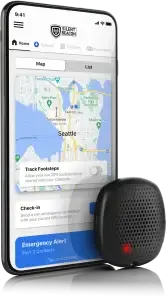
Enterprise safety requires redundancy, predictability, and coordination. Relying solely on consumer emergency features places organizations at risk and limits their ability to respond effectively during workplace incidents.
Safety leaders must ensure that enterprise emergency communication systems support the following:
Employees can summon help quickly and easily under stress
Internal response teams are notified immediately
Leadership has visibility into incidents as they occur
Emergency procedures work consistently across locations
Text to 911 can play a role in emergency access, but it cannot serve as a comprehensive workplace emergency communication solution for businesses.
Key Differences Between Text to 911 and Enterprise Emergency Alerting
| Capability | Text to 911 | Enterprise Emergency Alerting |
| Works without speaking | Yes | Yes |
| Functions when cell service is limited | In some cases | Yes, through multiple channels |
| Alerts internal safety teams | No | Yes |
| Supports mass notifications | No | Yes |
| Wearable panic button support | No | Yes |
| Real-time location tracking | Limited | Yes |
| Incident escalation workflows | No | Yes |
| Compliance and reporting | No | Yes |
Text to 911 improves emergency access for individuals, but it was never designed to manage workplace response or organizational duty of care. For businesses evaluating emergency communication systems, enterprise emergency alerting platforms exist to fill that gap by providing structure, coordination, and visibility during critical incidents.
How Silent Beacon Supports Enterprise Emergency Response
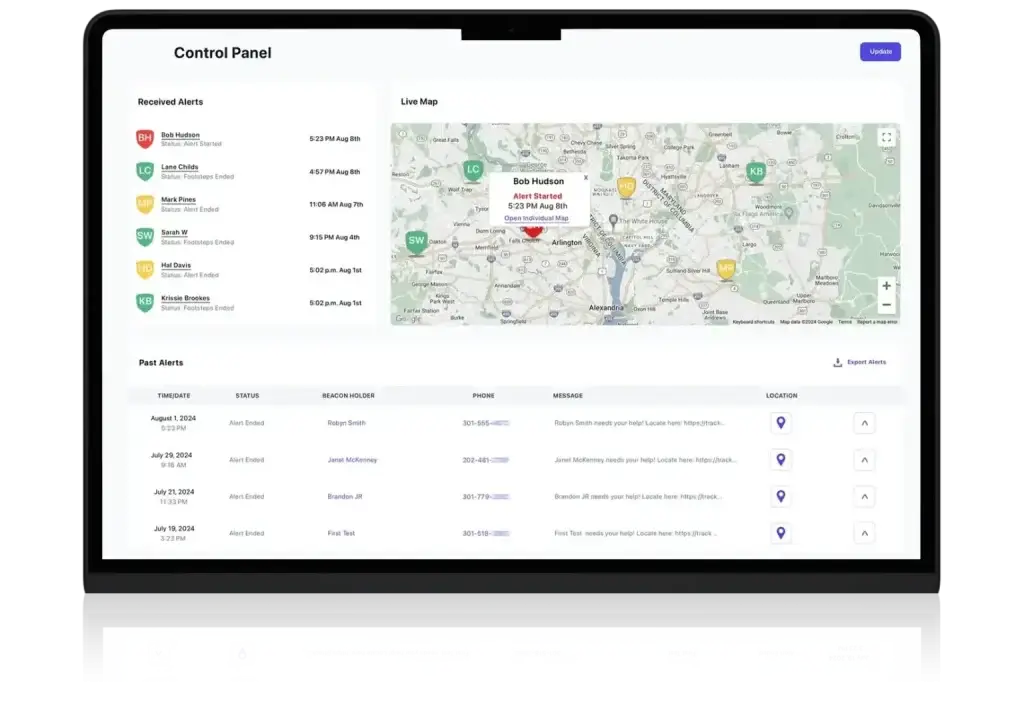
Silent Beacon is not a Text to 911 solution. Instead, it addresses enterprise emergency communication needs by enabling people to call for help quickly while ensuring internal teams and leadership can respond in a coordinated, informed way.
Direct 911 Calling with Wearable Panic Buttons
Silent Beacon allows users to initiate a direct 911 voice call using a wearable Bluetooth panic button or mobile app. This eliminates the need to dial numbers or navigate a phone during high-stress situations and avoids reliance on text-based emergency communication for business emergency response.
Immediate Alerts to Internal Safety Teams
When an alert is triggered, Silent Beacon notifies internal responders instantly via voice, text, and email. This ensures workplace emergency communication reaches security teams, supervisors, and administrators without delay.
Real-Time Location and Incident Visibility
Silent Beacon provides GPS location tracking and a cloud-based dashboard that gives organizations real-time insight into where incidents are occurring, strengthening enterprise emergency response coordination.
Silent and Hands-Free Emergency Signaling
Silent Mode allows users to discreetly signal for help when speaking or drawing attention could increase risk. Wearable panic buttons support faster, more reliable workplace emergency communication.
Enterprise-Grade Security and Rapid Deployment
Silent Beacon is SOC 2 compliant, supporting regulated industries such as healthcare, education, and government. The platform can be deployed in as little as two weeks with no infrastructure changes, supporting scalable enterprise emergency alerting for businesses.
Where This Difference Matters
Healthcare and Behavioral Health
Clinicians and caregivers need discreet, reliable ways to summon help while ensuring internal teams are alerted immediately through workplace emergency communication systems.
Education and Campus Safety
Schools and universities require coordinated response across staff, administrators, and law enforcement, which Text to 911 alone cannot provide for enterprise safety needs.
Government and Social Services
Field workers and inspectors benefit from wearable safety tools backed by real-time oversight and enterprise emergency alerting capabilities.
Commercial and Lone-Worker Environments
Retail, hospitality, real estate, and field service teams need simple emergency signaling that works consistently and supports business emergency response systems.
Text to 911 Is Progress. Enterprise Safety Requires Structure.
Advancements in Text to 911 are an important step forward for public safety, but they do not replace the need for enterprise emergency communication systems designed for businesses. Organizations remain responsible for providing layered, reliable safety solutions that protect people and support coordinated response.
Understanding the difference between Text to 911 for businesses and enterprise emergency alerting is key to building a safety strategy that works in real-world conditions.
Build a More Resilient Emergency Response Strategy
Learn how Silent Beacon helps organizations strengthen enterprise emergency communication through wearable panic buttons, real-time visibility, and internal alerting. Request a demo to see how modern workplace emergency response should work.
Schedule a Meeting with Our Safety Experts Today
Complete this simple form so we can prepare to tailor our safety solution options for your business and organization.