Workplace Violence Prevention Planning for Risk Managers

Executive Summary for Risk Managers
Workplace violence continues to be a persistent and evolving risk as organizations move into 2026. While federal injury data provides valuable historical context, recent 2025 industry reports show that employees across healthcare, education, retail, and public services are increasingly witnessing or experiencing violent incidents at work. This growing gap between reported incidents and lived experience places added responsibility on risk managers to strengthen prevention strategies.
Understanding the four types of workplace violence1 and implementing a documented workplace violence prevention plan is now a regulatory expectation under OSHA’s General Duty Clause2 and related accreditation standards. Effective prevention plans go beyond written policies. They combine risk assessments, training, clear reporting procedures, and real-time response capabilities that support employees during an incident, not just after one.
As expectations rise, many organizations are evaluating employee safety devices and workplace panic buttons as part of a modern prevention strategy. When every second counts, technology-enabled tools can help bridge the gap between policy and real-world action, supporting compliance, faster response, and greater peace of mind for employees and leadership alike.
What Do Workplace Violence Statistics Show Heading Into 2026?
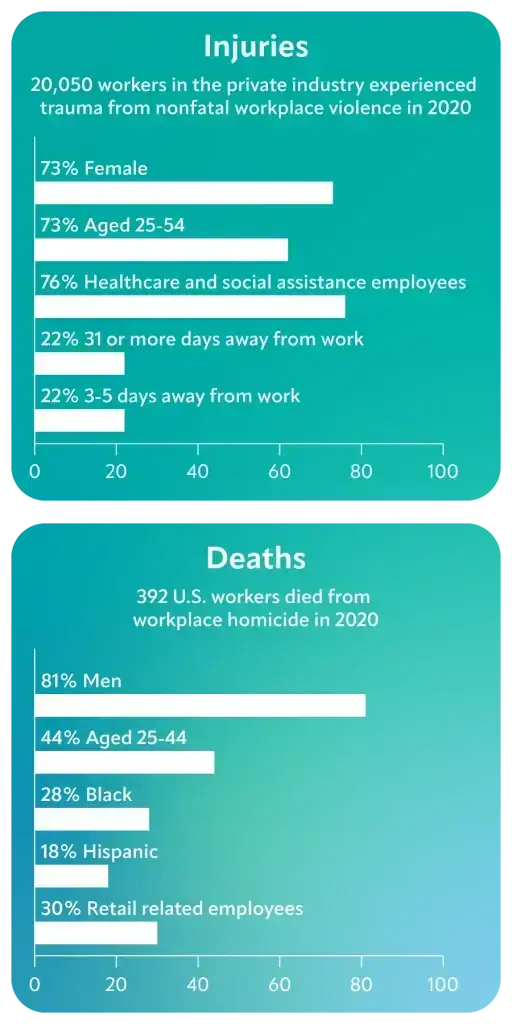
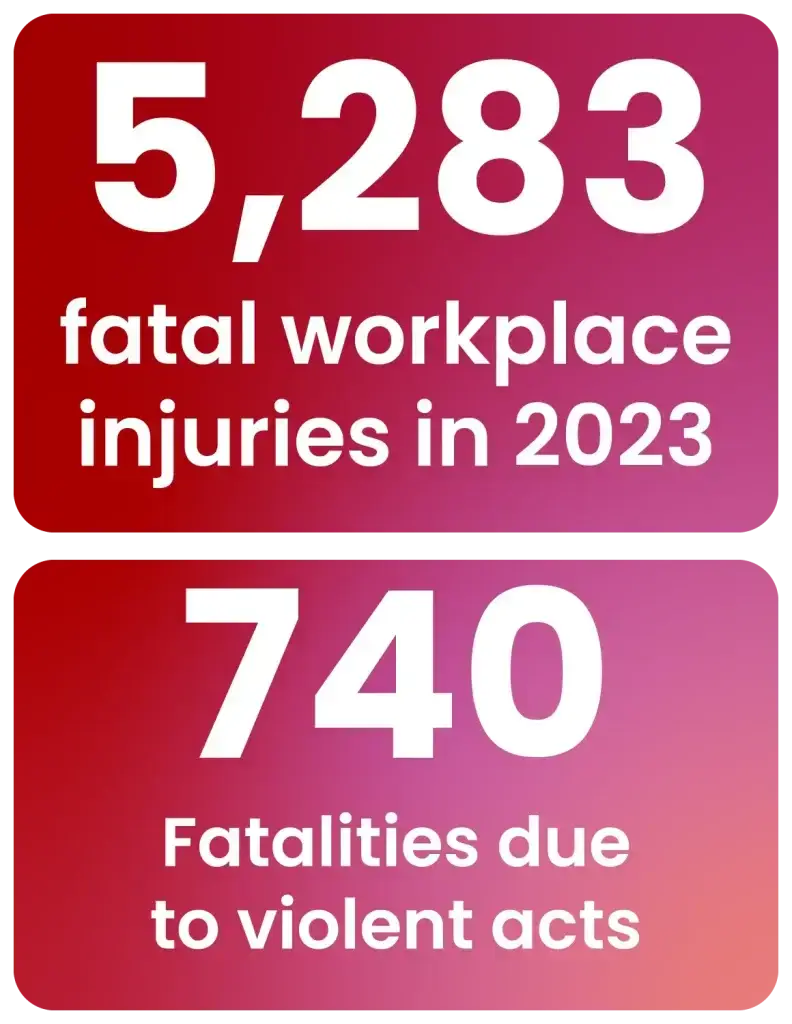
Workplace violence remains one of the leading causes of fatal occupational injuries in the United States. According to the U.S. Bureau of Labor Statistics (BLS), violent acts continue to disproportionately impact industries with frequent public interaction, including healthcare, retail, education, and government3. Nonfatal incidents, many of which go unreported, occur far more frequently than fatal events and contribute to long-term operational, legal, and reputational risk.
Recent 2025 industry surveys add important context to federal data. Employee-reported experiences suggest that workplace violence is not only persisting but becoming more normalized in certain roles. In multiple surveys conducted in 2025, a significant percentage of employees reported witnessing threats, harassment, or physical violence at work within the past year, according to Traliant’s 2025 Workplace Violence Report5.
For risk managers planning for 2026, these statistics highlight a critical reality: relying solely on lagging injury data may underestimate actual exposure. Prevention strategies must be built with current trends, not just historical averages, in mind.
The Four Commonly Recognized Types of Workplace Violence
The following four types of workplace violence are widely used by safety professionals and defined in CDC/NIOSH guidance1. While these classifications are formally codified in certain state regulations (such as California), they are commonly applied nationwide for workplace violence risk assessment and prevention planning. Each type presents distinct warning signs, risk factors, and prevention challenges. Each presents different warning signs, risk factors, and prevention challenges.
Type 1: Criminal Intent
This type involves perpetrators with no legitimate relationship to the workplace, such as robbery, trespassing, or random acts of violence. Retail environments, public buildings, and lone workers are especially vulnerable.
Type 2: Customer or Client Violence
The most common type of workplace violence. It involves patients, customers, students, or clients who become aggressive or violent. Healthcare, social services, education, and government agencies face heightened exposure due to emotional stressors and frequent public interaction.
Type 3: Worker-on-Worker Violence
This includes conflicts between current or former employees. These incidents may stem from unresolved disputes, workplace stress, or organizational culture issues.
Type 4: Personal Relationship Violence
This occurs when domestic or personal disputes spill into the workplace. These incidents are often unpredictable and difficult to identify without clear reporting mechanisms and response plans.
An effective workplace violence prevention plan must address all four types, not just the most visible or extreme scenarios.
Why a Workplace Violence Prevention Plan Is Now a Business Requirement
Regulatory expectations around workplace violence prevention continue to expand. Under OSHA’s General Duty Clause, employers are required to provide a workplace free from recognized hazards, including violence2. While OSHA does not mandate a single universal standard, enforcement actions increasingly reference whether employers took reasonable steps to identify and mitigate known risks.
In healthcare and social services, accrediting bodies such as The Joint Commission require organizations to assess workplace violence risks and implement mitigation strategies. At the state level, new legislation and guidance continue to emerge, particularly for public-facing and high-risk industries.
For risk managers, a documented workplace violence prevention plan is no longer simply a best practice. It is an essential component of compliance, liability management, and employee safety.
What Should a Workplace Violence Prevention Plan Include in 2026?
Leading organizations treat violence prevention as an ongoing program, not a static policy. An effective workplace violence prevention plan typically includes:
- Regular workplace violence risk assessments
- Clear reporting and escalation procedures
- Ongoing employee training and awareness
- Defined incident response protocols
- Technology-enabled safety measures that support real-time response
Regulatory guidance consistently emphasizes that prevention plans should be reviewed and updated regularly, particularly after incidents or near-misses5.
The Role of Employee Safety Devices and Workplace Panic Buttons
Policies and training are essential, but they cannot replace immediate access to help during a violent incident. Modern employee safety devices and workplace panic buttons play an increasingly important role in prevention and response strategies.
Unlike approaches that rely on verbal reporting or delayed escalation, wearable safety devices allow employees to discreetly request help in real time. This is especially important for lone workers, mobile staff, and employees in high-stress or public-facing roles.
When every second counts, direct access to emergency assistance and location awareness can significantly improve response outcomes and employee confidence, as noted by the National Safety Council6.
Comparison Table: Workplace Violence Prevention Approaches
| Feature | Traditional Prevention Approaches | Technology-Enabled Prevention |
|---|---|---|
| Incident Reporting | Verbal or post-incident | One-touch alert during incident |
| Response Speed | Delayed | Immediate notification |
| Employee Discretion | Limited | Silent alert options |
| Location Awareness | Manual or unavailable | Real-time location sharing |
| Support for Lone Workers | Minimal | Designed for lone staff |
| Prevention Plan Integration | Policy-focused | Embedded into daily operations |
| Compliance Support | Documentation-driven | Demonstrates active mitigation |
How Risk Managers Can Reduce Exposure Heading Into 2026
Preparing for 2026 requires a proactive approach:
- Reassess workplace violence risks annually
- Review response protocols after incidents or near-misses
- Validate that employees understand how to report concerns
- Deploy safety tools employees will actually use under stress
Recent 2025 research from the Crisis Prevention Institute shows that organizations with proactive prevention programs report higher employee confidence and improved incident response outcomes7.
Strengthen Your Workplace Violence Prevention Plan
See how safety technology supports faster response and employee protection.
Workplace Violence Prevention Plan Checklist for 2026
- Addresses all four types of workplace violence
- Includes annual risk assessments
- Defines clear reporting and escalation procedures
- Provides regular employee training
- Incorporates employee safety devices or panic buttons
- Supports lone and high-risk workers
- Is reviewed and updated regularly
Workplace Violence Prevention FAQs
What industries face the highest risk of workplace violence?
Healthcare, social services, education, retail, and government consistently report higher rates of workplace violence due to frequent public interaction and high-stress environments.
What are the four types of workplace violence?
They include criminal intent, customer or client violence, worker-on-worker violence, and personal relationship violence.
Is a workplace violence prevention plan required by OSHA?
OSHA does not mandate a single standard, but under the General Duty Clause, employers are expected to identify and mitigate recognized hazards, including workplace violence.
How often should a workplace violence prevention plan be updated?
Best practice is at least annually, or after any significant incident or near-miss.
Are workplace panic buttons required by law?
Some jurisdictions require panic buttons in specific industries. Even where not required, they are increasingly recognized as a best practice for high-risk environments.
Your Workplace Violence Prevention Plan Needs More Than Policies
Understanding workplace violence statistics is the first step. Building an effective workplace violence prevention plan is the next.
As a risk manager, you already know that awareness isn’t enough. Real employee safety at work requires actionable violence prevention strategies backed by reliable technology.
Silent Beacon’s workplace panic button provides the technology your employees need to access help instantly. Our employee safety device is built for high-risk work environments, lone worker safety , and public-facing teams who face multiple types of workplace violence daily.
Real-time alerts. GPS tracking. Instant response.
Stop relying on outdated safety measures. Integrate proven workplace safety technology into your comprehensive prevention strategy and give your team the tools they need to stay safe.
Strengthen Your Workplace Violence Prevention Plan Today
Equip your team with the workplace safety technology they need to stay protected in high-risk environments.
Sources & References
- CDC/NIOSH – Workplace Violence Prevention
https://wwwn.cdc.gov/WPVHC/Nurses/Course/Slide/Unit1_5
Official training module on classifications of workplace violence (Type 1: Criminal Intent; Type 2: Customer/Client; Type 3: Worker-on-Worker; Type 4: Personal Relationship) within the CDC/NIOSH Workplace Violence Prevention for Nurses course, used by safety professionals for understanding occupational violence risk in healthcare settings. - Occupational Safety and Health Administration (OSHA) – Workplace Violence Overview
https://www.osha.gov/workplace-violence
Regulatory guidance on employer responsibilities under the General Duty Clause, including definitions of workplace violence and compliance expectations. - U.S. Bureau of Labor Statistics (BLS) – Workplace Violence Data
https://www.bls.gov/iif/factsheets/workplace-violence-2021-2022.htm
Federal data on fatal and nonfatal workplace violence incidents, including industry-specific injury trends and statistical context for workplace violence prevention planning. - Traliant – 2025 Workplace Violence Report
https://www.traliant.com/resources/2025-workplace-violence-report/
Employee survey data reflecting current workplace violence trends and real-world incident reporting from 2025. - OSHA – Workplace Violence Prevention Programs
https://www.osha.gov/workplace-violence/prevention-programs
Best practices and framework for developing a comprehensive workplace violence prevention plan that meets regulatory standards. - National Safety Council (NSC) – Workplace Violence Topics
https://www.nsc.org/workplace/safety-topics/workplace-violence
Safety advocacy organization guidance on violence prevention strategies and the role of workplace safety technology in emergency response - Crisis Prevention Institute (CPI) – 2025 Annual Report
https://www.crisisprevention.com/globalassets/us-ca/resources/pdf/2025-annual-report-final.pdf
Industry insights on violence prevention strategies, employee safety perceptions, and organizational response effectiveness.