NIMS Explained: How the National Incident Management System Works with ICS

Key Takeaways
- NIMS (the National Incident Management System) is FEMA’s nationwide framework that gives government agencies, nonprofits and private organizations a shared vocabulary, structure and set of processes for managing any incident, from a building fire to a hurricane. The current edition is the third, released in October 2017.
- NIMS has three components: Resource Management, Command and Coordination, and Communications and Information Management.
- ICS sits inside NIMS. The Incident Command System is one of four Command and Coordination structures in NIMS, alongside Emergency Operations Centers, Multiagency Coordination Groups and the Joint Information System.
- Adoption is required for some and voluntary for others. State, local, territorial and tribal jurisdictions must adopt NIMS to receive federal preparedness grants. Private employers are not required to, but aligning with it makes it far easier to work alongside responders when an incident reaches your site.
- The baseline training is free and online: FEMA’s IS-700 (NIMS, an Introduction) and ICS-100 (Introduction to the Incident Command System).
NIMS, the National Incident Management System, is the national framework the Federal Emergency Management Agency (FEMA) uses to make sure every organization responding to an incident speaks the same language and follows the same structure. If your organization ever has to hand an emergency to police, fire or EMS, or coordinate with a county emergency manager, NIMS is the playbook they are running, and knowing how it works decides how smoothly that handoff goes.
What Problem NIMS Solves
Most incidents are not managed by one organization. A workplace violence incident at a clinic can involve the clinic’s own staff, a security contractor, local police, EMS, a hospital emergency department and, later, investigators. A severe storm can pull in public works, utilities, schools, the Red Cross and state agencies at the same time.
Without a common system, each group arrives with its own job titles, radio habits, resource names and chain of command. Two agencies can mean different things by the same word, a request for “a team” can bring the wrong people, and nobody is sure who is actually in charge. Those gaps cost time, and in an emergency, time is the resource that matters most.
NIMS exists to close those gaps. FEMA describes it as guidance for “all levels of government, nongovernmental organizations and the private sector to work together” to prevent, protect against, mitigate, respond to and recover from incidents (FEMA, National Incident Management System). In practice, that means the same terms, the same organizational structure and the same processes, whether the incident is a single injured worker or a multi-county disaster.
Where NIMS Came From
NIMS grew out of the response to the September 11, 2001 attacks, which showed how hard it was for agencies from different jurisdictions and disciplines to work together under pressure.
| Year | Milestone |
|---|---|
| February 28, 2003 | President George W. Bush issues Homeland Security Presidential Directive 5 (HSPD-5), “Management of Domestic Incidents,” calling for a single, comprehensive national incident management system (HSPD-5). |
| March 1, 2004 | The Department of Homeland Security releases the first NIMS document. |
| December 2008 | NIMS is revised to clarify concepts and refine processes and terminology, without major policy changes (NIMS, December 2008). |
| October 2017 | FEMA releases the third edition, the version in use today (NIMS, Third Edition). |
The Incident Command System itself is older than NIMS. ICS was developed in the 1970s after a series of catastrophic California wildfires exposed how poorly agencies coordinated on large fires. NIMS took that proven field system and made it part of a national framework. For the full story of how ICS developed, see our guide to the Incident Command System: History, Structure, and Modern Applications.
The Three NIMS Components
The 2017 edition organizes NIMS into three components. Each one answers a different question that comes up in every incident.
1. Resource Management: what do we have, and how do we get more?
Resource Management covers how organizations identify, order, track and share people, teams, equipment and supplies before and during an incident. It includes:
- Resource typing: standard names and capability definitions, so a request for a specific type of team or piece of equipment means the same thing in every jurisdiction.
- Qualification, certification and credentialing: a consistent way to confirm that the people being deployed are trained for the role.
- Mutual aid: agreements that let one jurisdiction or organization share resources with another when its own run short.
2. Command and Coordination: who is in charge, and how do decisions get made?
Command and Coordination defines how incidents are led and how leaders at different levels work together. NIMS 2017 describes four structures within it:
| Structure | What it does |
|---|---|
| Incident Command System (ICS) | Manages the on-scene, tactical response: objectives, assignments and resources at the incident itself. |
| Emergency Operations Centers (EOCs) | Physical or virtual locations where staff from multiple organizations gather to support the on-scene response with information, resources and coordination. |
| Multiagency Coordination Groups (MAC Groups) | Policy-level groups, often senior officials or executives, that set priorities and allocate scarce resources across incidents. |
| Joint Information System (JIS) | Coordinates public information so that every agency involved gives the public consistent, accurate messages. |
3. Communications and Information Management: how does information flow?
This component ensures that responders and decision makers can share accurate information when they need it. It covers interoperable communications (people on different systems can still reach each other), standard procedures for collecting and sharing incident information, and the security and resilience of the communications themselves. NIMS treats this as a component of its own, not a detail, because every other part of the response depends on accurate information reaching the right people.

How NIMS and ICS Fit Together
The simplest way to think about it: NIMS is the overall framework, and ICS is the part of it that runs the scene.
| NIMS | ICS | |
|---|---|---|
| What it is | A national framework for incident management | A standardized on-scene management structure |
| Scope | Preparedness, resource sharing, coordination and communications across every level | Command, operations, planning, logistics and finance at a specific incident |
| Who uses it | Governments, nonprofits, private organizations, from local to federal | Whoever is managing the incident on the ground |
| Relationship | Contains ICS as one of four Command and Coordination structures | Operates inside NIMS and follows its management characteristics |

The 14 NIMS management characteristics
ICS is built on 14 management characteristics that NIMS defines as the foundation of incident command and coordination (FEMA, ICS Review Document):
- Common Terminology
- Modular Organization
- Management by Objectives
- Incident Action Planning
- Manageable Span of Control
- Incident Facilities and Locations
- Comprehensive Resource Management
- Integrated Communications
- Establishment and Transfer of Command
- Unified Command
- Chain of Command and Unity of Command
- Accountability
- Dispatch/Deployment
- Information and Intelligence Management
A few of these shape everyday decisions more than the rest. Manageable span of control sets a guideline of one supervisor to five people, adjusted to the situation. Chain of command and unity of command means every person reports to exactly one supervisor. Establishment and transfer of command means command is formally handed over, with a briefing, whenever a more qualified person arrives, which is exactly what happens when your on-site lead hands an incident to arriving fire or police.
The ICS structure and roles
ICS organizes an incident around an Incident Commander, or a Unified Command when several agencies share authority, supported by two groups of staff:
- Command Staff: the Public Information Officer (communicates with the public and media), the Safety Officer (identifies hazards and has the authority to stop unsafe acts) and the Liaison Officer (the point of contact for other agencies).
- General Staff: the Operations, Planning, Logistics and Finance/Administration Sections, each led by a Section Chief who reports to the Incident Commander. An Intelligence/Investigations function can be added when an incident calls for it, either within a section or as its own section.
Because ICS is modular, only the positions an incident actually needs get filled. On a small incident, the Incident Commander may handle every function personally.

Who Has to Follow NIMS
NIMS applies differently depending on what kind of organization you are.
- Government jurisdictions. FEMA states that local, state, territorial and tribal nation jurisdictions are required to adopt NIMS to receive federal preparedness grants (FEMA). In practice, that makes NIMS the standard for public safety, emergency management and most public agencies.
- Healthcare organizations. The Administration for Strategic Preparedness and Response (ASPR) has tied NIMS implementation to Hospital Preparedness Program funding and publishes NIMS implementation guidance written for healthcare organizations (ASPR TRACIE).
- Private employers and nonprofits. Private companies are not required to adopt NIMS. But any serious incident at a workplace ends with public responders running ICS, so a business that already uses the same terms and roles can hand off faster and plug into the response instead of standing outside it.
How a Business Can Align with NIMS
You do not need a full emergency management department to work the NIMS way. These steps cover most organizations:
- Train the right people. FEMA’s baseline NIMS courses are IS-700 (NIMS, an Introduction) and ICS-100 (Introduction to the Incident Command System), both free online. Supervisors who may lead an initial response can add ICS-200 (Basic Incident Command System for Initial Response), and staff who will work in an operations center can take IS-2200 (Basic Emergency Operations Center Functions) (FEMA EMI, ICS Resource Center).
- Name your roles before you need them. Decide who acts as your incident lead, who talks to responders (your liaison) and who handles internal and public communication. Write it into your emergency action plan.
- Use plain, common terms. Drop internal codes from emergency procedures. Common terminology is the first of the 14 NIMS management characteristics for a reason: the people arriving to help will not know your internal shorthand.
- Know how you will alert people and account for them. Integrated communications and accountability are two of the 14 characteristics for a reason. Decide in advance how a worker in trouble calls for help, how you will notify everyone else and how you will confirm who is safe.
- Practice the handoff. Run exercises that end with your team transferring command to arriving responders, including a short briefing on what has happened, what has been done and where your people are.
How Silent Beacon Supports a NIMS-Aligned Response
NIMS gives you the structure. What it cannot do is make sure the first report of an incident reaches the right people quickly, or that leaders have accurate information once it does. That is where Silent Beacon fits, particularly for organizations with staff who work alone or away from the main site.
- Integrated communications from the first alert. When a worker activates Silent Beacon’s 2.0 panic button, Emergency Alert Mode calls the number the organization chooses, which can be 911, through the device’s built-in two-way speakerphone, using the paired phone’s connection over Bluetooth®. At the same moment, text, email and push notifications with the worker’s GPS location go to designated contacts. Help is summoned without the worker stopping to dig out or unlock a phone, and the right people learn about the incident at the same time.
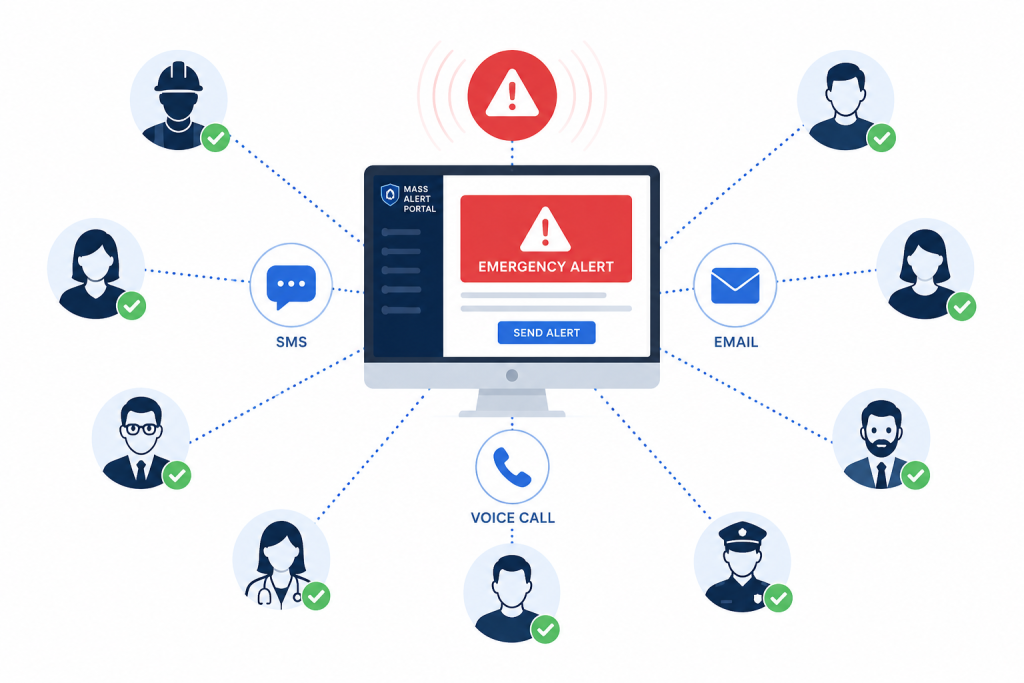
- Mass notification for everyone else. Once an incident is underway, the next problem is telling everyone who needs to know. Silent Beacon’s mass notification system sends alerts by text, email and voice call to targeted groups (a site, a shift, a department) or the whole organization, which supports the consistent messaging NIMS calls for. For more on how these systems developed, see Emergency Notification Systems: Evolution, Use Cases, and the Silent Beacon Advantage.
- Accountability and a record of what happened. The Control Center keeps a history of alerts, notifications and activity, which supports accountability during the incident and gives planners an accurate timeline for the after-action review.
- Privacy that workers can trust. Location is shared only during an active alert, so a safety tool built for emergencies does not become everyday tracking.
None of this replaces your incident command structure. It supports the parts of it, communications, information management and accountability, where delays and gaps most often appear.
Frequently Asked Questions.
What does NIMS stand for?
NIMS stands for the National Incident Management System. It is FEMA’s national framework that gives every level of government, nonprofits and the private sector a shared vocabulary, structure and set of processes for managing incidents of any size or type.
What is the difference between NIMS and ICS?
NIMS is the overall national framework for incident management, covering resources, coordination and communications. ICS, the Incident Command System, is one part of NIMS: the standardized structure used to manage the on-scene response, led by an Incident Commander with Command and General Staff.
What are the three components of NIMS?
The three components of NIMS are Resource Management, Command and Coordination, and Communications and Information Management. Command and Coordination includes four structures: the Incident Command System, Emergency Operations Centers, Multiagency Coordination Groups and the Joint Information System.
Is NIMS mandatory for private companies?
No. NIMS is required for state, local, territorial and tribal jurisdictions that want federal preparedness grants, but private companies are not required to adopt it. Training key staff in NIMS and ICS basics is still worthwhile, because public responders use ICS at any serious incident and a shared structure makes the handoff faster.
Which NIMS training courses should my staff take?
FEMA’s baseline courses are IS-700 (NIMS, an Introduction) and ICS-100 (Introduction to the Incident Command System), both free and online. Supervisors who may lead an initial response often add ICS-200, and staff who will work in an emergency operations center can take IS-2200.
Put NIMS into Practice
NIMS gives your organization the same playbook public responders use, and the payoff comes in the first minutes of an incident, when the right people need to know what is happening and who is in charge. If your teams include staff who work alone or off-site, make sure the way they call for help, and the way you notify everyone else, is as clear as your command structure.