Workplace Panic Buttons: 2026 Enterprise Safety Guide

Most workplace violence never makes the news. It happens in a patient room, a stockroom, a parking lot or a client’s home, usually to one employee who is alone and can’t easily call for help. For employers, the question is no longer whether it could happen. It’s how fast your team can respond when it does.
This guide covers what the latest data says about workplace violence, which laws now require employers to act, and what to look for in a workplace panic button system. It ends with a simple rollout plan you can use this quarter.
Key takeaways
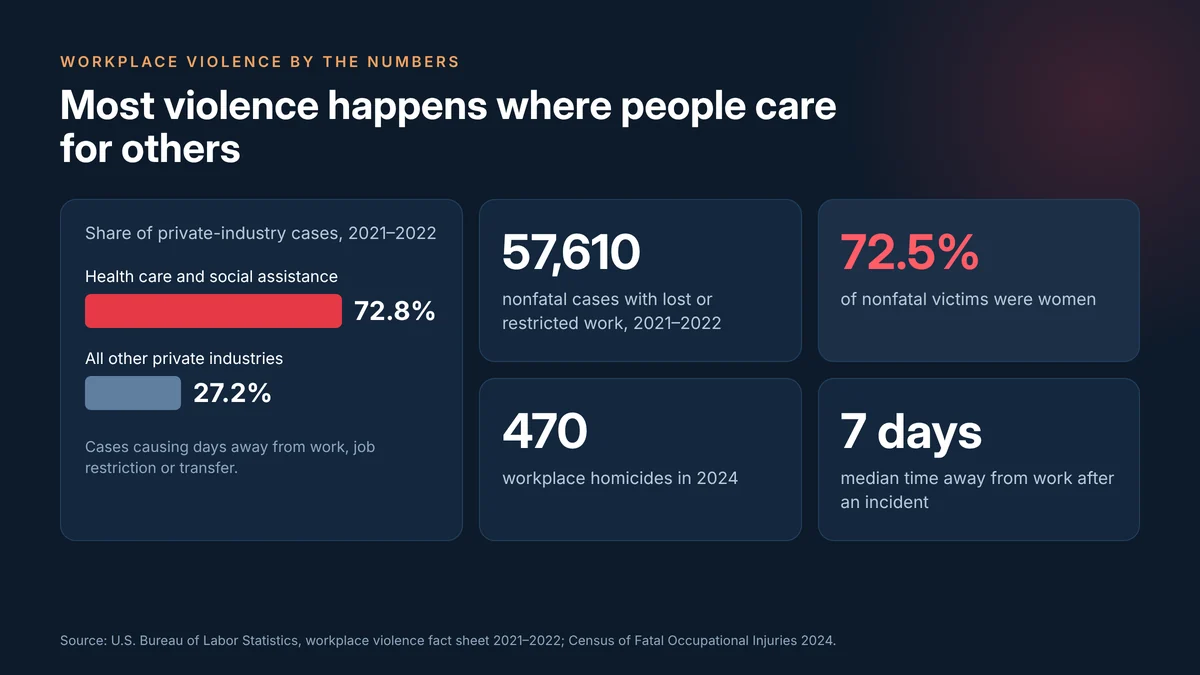
- U.S. employers recorded 57,610 nonfatal workplace violence cases serious enough to cause lost or restricted work in 2021 and 2022, according to the Bureau of Labor Statistics.
- Health care and social assistance accounted for 72.8% of those cases in private industry, and women were 72.5% of victims.
- Laws in California, New York, New Jersey, Illinois and other states now require prevention plans, training or panic buttons for certain workers.
- A good enterprise panic button sends a silent alert with location to the right responders in seconds, works for employees on and off site, and creates a record you can use for compliance.
What the data says about workplace violence
The Bureau of Labor Statistics (BLS) tracks workplace violence through two federal programs: one for injuries and one for deaths. Together they show a problem that is steady, serious and concentrated in a few industries.
In its most recent workplace violence fact sheet, BLS reports 57,610 nonfatal cases of workplace violence that required days away from work, job restriction or transfer across 2021 and 2022. That works out to an annual rate of 2.9 cases for every 10,000 full-time workers. Among cases that involved time off, the median worker missed 7 days.
The deadliest cases are rarer but are not going away. The BLS Census of Fatal Occupational Injuries counted 470 workplace homicides in 2024, up from 458 the year before. Shootings accounted for 379 of those deaths.
Who is most at risk
Risk is not spread evenly. Health care and social assistance accounted for 72.8% of all private-industry workplace violence cases in the BLS data. Nurses, behavioral health clinicians, home health aides and case managers face patients and clients in crisis every day, often alone. We cover those roles in more depth in our guides to panic buttons for behavioral health clinicians and case manager safety in the field.
Other high-risk groups include retail and hospitality staff who handle cash or work late, hotel housekeepers who work alone in guest rooms, educators and school staff, public sector workers who deal with upset members of the public, and anyone who works alone in the field.
Women carry a heavier share of the risk: they were 72.5% of nonfatal workplace violence victims in the same BLS data. That matters for how you choose and roll out safety tools, because the people most likely to need help are often in roles where a phone call isn’t safe or practical.
Most organizations are not ready
Many employers know the risk but haven’t built a response. In a SHRM survey of HR professionals, 48% said their organization had experienced workplace violence, up from 36% in an earlier survey. In a companion survey of employees, only 45% said their organization had a program to prevent workplace violence, and 49% said they had received training on how to respond.
That gap between risk and readiness is where incidents get worse. When an employee has no fast, discreet way to call for help, seconds turn into minutes.
The laws now requiring employers to act
There is still no federal OSHA standard written specifically for workplace violence. Instead, OSHA relies on the General Duty Clause, which requires employers to protect workers from recognized hazards. States have stepped in with their own rules, and many of them name panic buttons or alert systems directly.
California SB 553
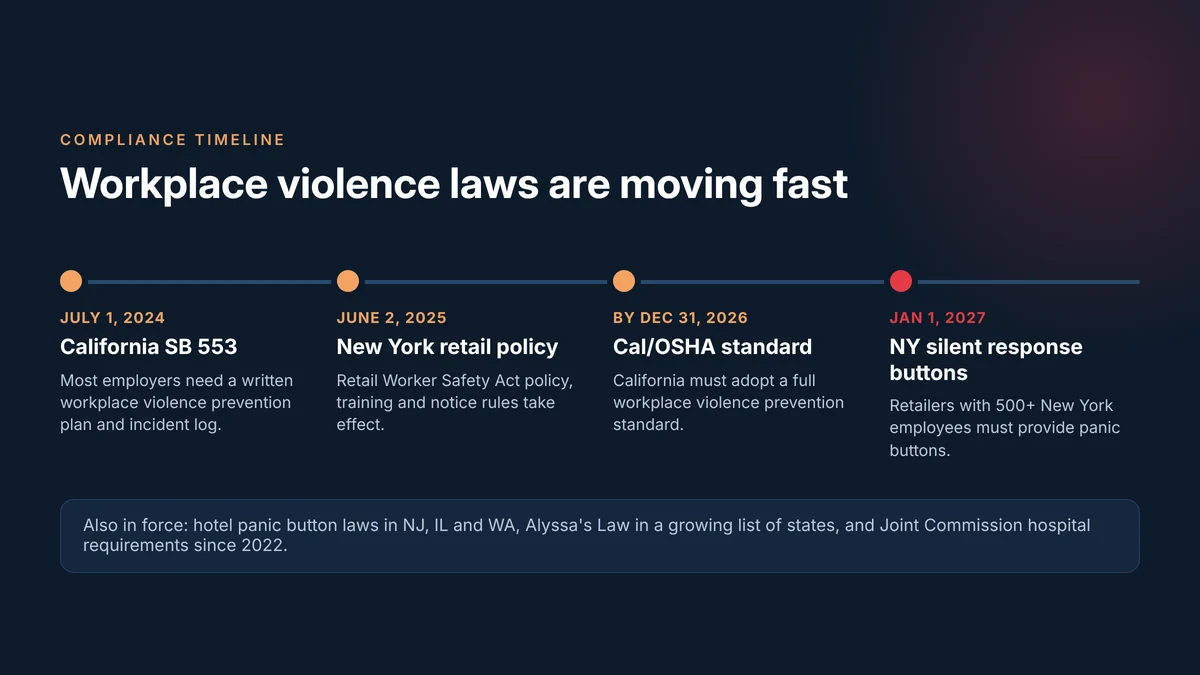
Since July 1, 2024, most California employers must have a written Workplace Violence Prevention Plan under Labor Code 6401.9. As Pillsbury’s summary of SB 553 explains, the plan must cover how employees report incidents, hazard assessments, a violent incident log, training, and how the employer responds to actual and potential emergencies. Logs and records must be kept for at least five years, and Cal/OSHA must adopt a full workplace violence standard by December 31, 2026.
New York Retail Worker Safety Act
New York’s Retail Worker Safety Act requires covered retailers to adopt a workplace violence prevention policy and train employees, with those rules in effect since June 2, 2025. Starting January 1, 2027, retailers with 500 or more employees in the state must also provide silent response buttons that request immediate help from security or a manager. According to Perkins Coie, those buttons can be fixed near workstations, worn by employees or accessed through their phones. New York hospitals have their own requirements, covered in our guide to the New York hospital workplace violence law.
Hotels, schools and hospitals
- Hotels: New Jersey requires panic buttons for hotel room cleaners at larger properties. Illinois, Washington and cities including Chicago, Seattle and New York City have similar rules.
- Schools: Alyssa’s Law, now passed in a growing number of states, requires silent panic alarms that connect schools to law enforcement. See how it works in our Illinois Alyssa’s Law guide.
- Hospitals: The Joint Commission’s workplace violence prevention requirements for accredited hospitals took effect in 2022, and California has required alarm systems in high-risk hospital units since 2017.
Even if your state has no specific mandate yet, these laws show where the standard of care is heading: a written plan, trained staff, a fast way to call for help, and a record of every incident.
How an enterprise panic button system works
An enterprise safety solution connects three things: a device the employee can trigger discreetly, software that routes the alert to the right people, and a dashboard that lets your safety team manage users, sites and incidents.
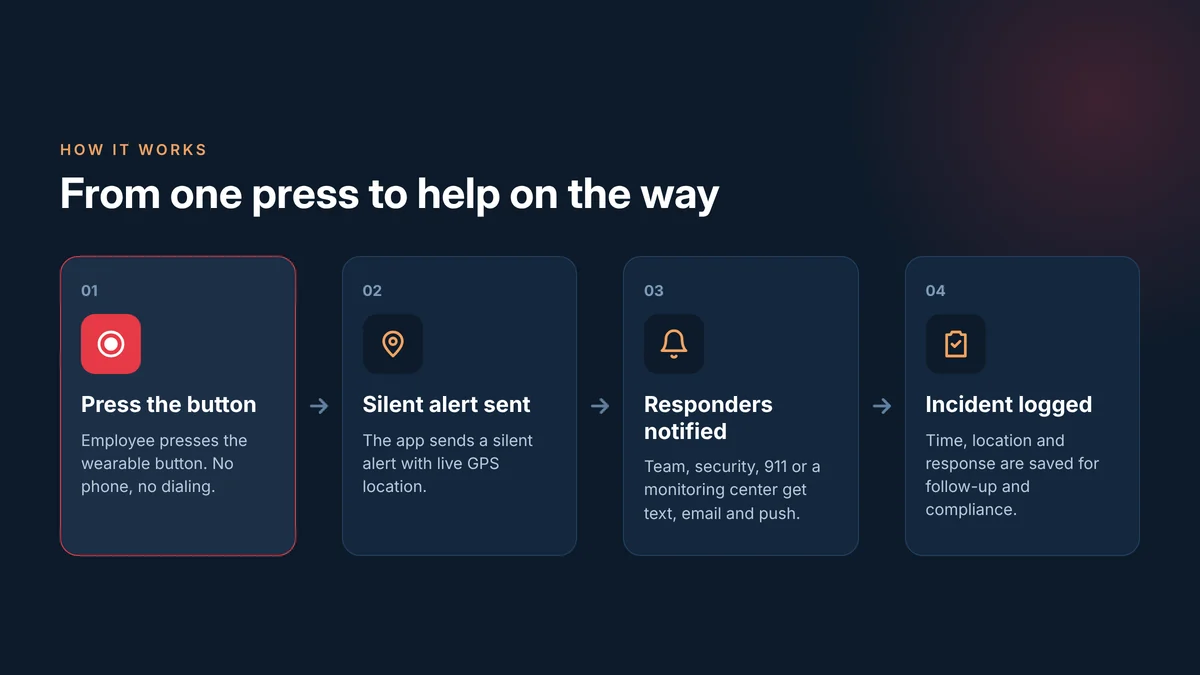
- Trigger: The employee presses a small wearable button worn on a wristband, clip or keyring. No unlocking a phone, no dialing and nothing that escalates the situation.
- Alert: The button connects to the employee’s phone over Bluetooth, and the app sends a silent alert with the employee’s live GPS location.
- Response: Designated coworkers, supervisors or security receive the alert by text, email and push notification, so the nearest person can respond. Alerts can also include a call to 911 or a professional monitoring center.
- Record: Every alert is logged in a central dashboard with time, location and responder details, which supports incident logs required under laws like SB 553.
What to look for in a workplace panic button
Not every panic button fits every workplace. A fixed button under a desk protects a front desk, but it does nothing for a home health aide or a field technician. Use this checklist when you compare options.
| What to check | Why it matters |
|---|---|
| Wearable and discreet | Employees can call for help without reaching for a phone or alerting the person causing the threat. |
| Works on and off site | GPS location protects staff in parking lots, client homes and the field, not only at a fixed desk. |
| Routes to the right people | Alerts go to nearby coworkers, supervisors, security, 911 or a monitoring center, based on your response plan. |
| Long battery life | A device that needs charging every night will be left at home. Look for weeks of battery, not hours. |
| Central dashboard | Your safety team can add users, manage groups, view alerts on a live map and send mass notifications. |
| Reporting for compliance | An automatic record of every alert helps you keep violent incident logs and show regulators your plan works. |
| Fast rollout | Cloud software and app-based setup let you protect a pilot group in days instead of months. |
Fixed panic buttons vs. wearable panic buttons
Fixed buttons are wired into a building’s alarm system. They work well at reception desks, nurses’ stations and cash registers, but only when the employee can reach them. Wearable buttons move with the employee, so they cover hallways, patient rooms, parking lots and off-site visits. Many organizations use both, with wearables for anyone who works alone or away from a fixed station. For office settings, see our office panic button solutions.
A five-step plan to roll out employee safety technology
Technology works best as part of a plan. These five steps line up with what SB 553 and similar laws expect, so the same work supports compliance and safety.
- Assess your risk. List the roles that work alone, handle cash, serve the public or visit clients. Review past incidents and near misses.
- Write or update your response plan. Decide who responds to an alert at each site, when to call 911, and how incidents get reported and reviewed.
- Start with a pilot group. Equip your highest-risk team first. Set up response groups, test alerts and fix gaps before you expand.
- Train everyone. Show employees how and when to use the button, and train responders on what to do when an alert comes in. Run drills.
- Review the data. Use dashboard reports to track alerts, response times and hot spots. Update your plan and hazard assessments as you learn.
How Silent Beacon Enterprise Safety Solutions help
Silent Beacon Enterprise Safety Solutions (ESS) give every employee a discreet wearable panic button and give your safety team one place to manage it all. Health care systems, behavioral health providers, schools, government agencies and businesses use Silent Beacon to protect staff on site and in the field.
- Wearable panic button: Worn as a watchband, clip or keyring, water resistant to IPX4, with up to 42 days of battery life.
- Silent alerts with location: One press sends a silent alert with live GPS location to the responders you choose by text, email and push notification.
- Escalation options: Route alerts to coworkers, supervisors, security, 911 or a 24/7 monitoring center.
- Control Center dashboard: Manage users and groups, see active alerts on a live map, send mass notifications and pull reports for your incident log.
- Fast deployment: App-based setup means you can protect a pilot team quickly and scale across sites.
See Silent Beacon in action
Get a live demo of the wearable panic button and Control Center, built around your sites, roles and response plan. We’ll show you how a pilot works and send a quote for your team.
Frequently asked questions
What is a workplace panic button?
A workplace panic button is a device employees press to call for help during a threat or emergency. Fixed buttons are mounted at a desk or station. Wearable buttons go with the employee and send a silent alert with their location to coworkers, security, a monitoring center or 911.
Are employers required to provide panic buttons?
It depends on your state and industry. New Jersey, Illinois, Washington and several cities require them for hotel workers. Alyssa’s Law states require silent alarms in schools. New York will require silent response buttons for retailers with 500 or more employees starting January 1, 2027. California requires most employers to have a written workplace violence prevention plan.
Which industries have the most workplace violence?
Health care and social assistance accounted for 72.8% of private-industry workplace violence cases that caused lost or restricted work in 2021 and 2022, according to BLS. Retail, hospitality, education, public administration and transportation also carry elevated risk.
How does a wearable panic button help lone workers?
Lone workers often can’t reach a fixed alarm or safely make a phone call. A wearable button lets them call for help with one press, and GPS location tells responders where to go, even in a parking lot, a client’s home or a remote site.
How quickly can we deploy Silent Beacon?
Because Silent Beacon is app-based with a cloud dashboard, most organizations start with a pilot group and expand from there. Get a quote and we’ll map out a timeline for your sites.