Beacon Spotlight: New York Public Radio

A Century of Resilience. A New Priority: Protecting the People Behind the Stories.

When you’ve been on the air for over 100 years, you learn a thing or two about resilience. New York Public Radio, the nonprofit media organization behind WNYC, WQXR, Gothamist, and a portfolio of acclaimed podcasts, has weathered everything from Hurricane Sandy to 9/11 to a global pandemic without missing a single broadcast. But in recent years, a different challenge started keeping their Chief Technology Officer, Steve S., up at night: the safety of lone workers heading out the door every morning into one of the most dynamic cities on earth.

This is the story of how a century-old institution found a modern, elegantly simple employee safety solution to protect its most important asset: its people.

Key Takeaways

  1. The client: New York Public Radio, the nonprofit behind the century-old WNYC and Gothamist, with a newsroom of reporters publishing daily.
  2. The challenge: Protecting journalists who work alone in unpredictable, sometimes dangerous, field environments.
  3. The solution: Silent Beacon devices with live GPS tracking and one-touch check-ins, deployed and field-ready in under half a day.
  4. The proof: Relied on for real high-stakes assignments, from an investigative porch-pirate sting in the Bronx to election-night coverage across the metro area.
  5. The result: Now standard equipment for the newsroom’s highest-risk reporters and editors, and expanding to more teams.

100 Years, One Mission

From its single headquarters in Soho, roughly 300 staff members power an extraordinary operation: multiple broadcast streams across eight transmitter sites in the tri-state area, a public theater, a newsroom publishing daily under the Gothamist brand, and a podcasting operation that delivers a petabyte of audio data every month. The organization’s earliest recording dates back to 1927, when Charles Lindbergh accepted the Medal of Valor.
“You can have all the redundancy built into your systems, but there’s always a requirement to really look at your redundancies. We never imagined we’d need a redundant building. After 9/11, instead of just rebuilding one transmitter site, we built two.”

– Steve S., Chief Technology Officer, New York Public Radio
Steve has been with the organization for 39 years, starting in the 1980s as an entry-level broadcast engineer working out of the station’s remote broadcast van at venues like Carnegie Hall and Avery Fisher Hall. He rose to become director of engineering, a role that put him at the center of one of the station’s most difficult chapters: rebuilding after the transmitter was lost atop One World Trade Center on September 11, 2001. That instinct for preparing for the scenario nobody expects is what eventually led Steve to Silent Beacon.

100+
YEARS

of public media and journalism


~300 EMPLOYEES

WNYC • WQXR • Gothamist Multiple broadcast & podcast operations

When a Group Chat Isn't Enough

Infographic showing how Silent Beacon closes the gap between building security, cybersecurity, and broadcast resilience to protect lone reporters in the field at New York Public Radio.
As CTO and the organization’s de facto Chief Security Officer, Steve oversees everything from broadcast engineering and IT to facilities security and threat intelligence. But the real vulnerability wasn’t the buildings. It was the reporter, alone, in the field. The tipping point wasn’t a single dramatic incident. It was a pattern. Managers kept coming to Steve with variations of the same conversation: “We’ve got someone going out on a job. It might be a little dangerous. We’ve set up a messaging channel for them. Just wanted to let you know.”
“You get a couple of those, and it just doesn’t sit well with you. There’s gotta be something we can do better.”
Steve paints a vivid picture of his newsroom. During the earliest days of COVID-19, when the suburb of New Rochelle was locked into a one-mile-square quarantine zone, two reporters told their newsroom manager they wanted in. They had a hotel room lined up and planned to quarantine for fourteen days and report from inside the zone.
“The newsroom manager went to legal and senior leadership. ‘Are we really going to let this happen?’ And we did. These people, God bless them, they want the story. They want to report on it for the benefit of the community.
That fearless drive is what makes Gothamist’s journalism powerful. It’s also what makes protecting those reporters non-negotiable. Steve explored options like police-style body cameras, but they were too complex and too bandwidth-heavy. He needed a lone worker safety solution that was resilient, private, and above all, simple. Then he found Silent Beacon.

Traditional Approach

Silent Beacon

The Porch Pirates

“I was given about half a day to prepare. I said, ‘All right, we’re going to spin him up with Silent Beacon immediately.’ We got it set up. We trained him. We trained his supervisors. That was my first time using it in a real scenario, so I needed a hands-on feel for it. And we put him out there.”

Steve purchased ten Silent Beacon devices in the fall of 2024. After a couple of months of internal testing, the first real field deployment came fast, with about half a day’s notice.

The Gothamist newsroom had been working on an investigative story about porch pirates in the Bronx. The reporters devised a clever sting: they bought three Amazon packages, hid Apple AirTagâ„¢ tracking devices inside, resealed them with authentic Amazon tape, and placed them on porches in the target area.

All three were stolen.

Now a lone reporter was heading into the Bronx, in the evening, to track the AirTag signals and confront the thieves.

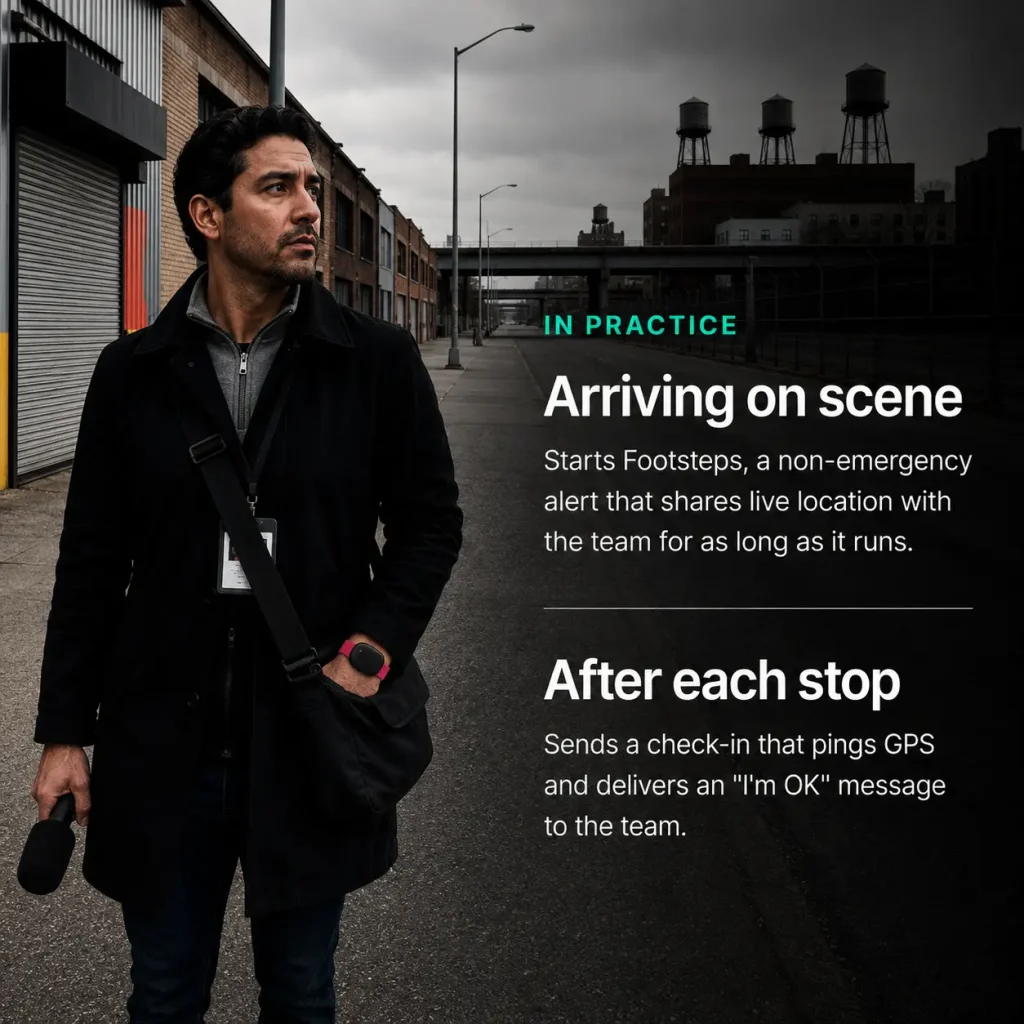
The reporter activated live GPS tracking the moment he arrived. His supervisors followed his movements in real time, and he used the check-in feature to confirm he was safe after each stop.
“We felt that we were providing a real level of security for him. Would I do it differently now? I would. I’d still give him the Silent Beacon, but I’d also have an executive protection agent in a car following him. But you learn this way.”
The story ran. It served the community. And Silent Beacon had proven its value on its very first night in the field.

Election Night and Beyond

Infographic showing how New York Public Radio used Silent Beacon during election night coverage to equip six reporters with real-time visibility and support high-risk field reporting.
During the November 2025 election, Steve outfitted six reporters with Silent Beacon devices as they covered polling locations across the metro area.
“There was a lot of hype leading up to it. Six o’clock in the morning, I remember Paterson, New Jersey, there were bomb threats at multiple locations. It turned out to be a hoax, but I was glad we had the Silent Beacon devices. The reporters could check in and give us visibility on where they were.”
Today, seven or eight of the newsroom’s highest-risk reporters and editors keep Silent Beacon devices at their desks and take them into the field for criminal investigations, court proceedings, protests, and breaking news.

Why It Works: Privacy, Resilience, Simplicity

When asked what criteria mattered most in choosing an employee safety device, Steve’s answer was immediate:
“Privacy, resilience, and simplicity. That’s it.”
Privacy was critical for earning buy-in from a fiercely independent newsroom. Silent Beacon is not an always-on monitoring tool. Reporters activate GPS tracking only when they choose to. As Steve put it: “No one wants to be tracked. But when you need it, you want it.” Simplicity won the day because the device pairs to a phone the reporter already knows and trusts, and the price point let Steve green-light the purchase himself.

PRIVACY

GPS tracking is activated when needed rather than functioning as an always-on monitoring system.

RESILIENCE

Built for employees who may find themselves working in unpredictable environments.

SIMPLICITY

Pairs with the phone employees already know how to use.

"There Would Be Stories We Could Not Cover"

For Steve, the return on investment goes far beyond operational metrics. New York Public Radio is a nonprofit whose mission depends on reporters being able to go into difficult situations and bring the truth back to the community. That work has real consequences. One of the organization’s podcasts once uncovered enough ambiguity in a closed murder case that a New Jersey district attorney reopened the investigation.
“The ability to give reporters the confidence and security to go into these situations allows us to best serve the public. If we can’t meet the public’s needs or affect positive change for our community, then why be in business?”
And the cost of not having a solution?
“There would definitely be stories we would not be able to cover. We would not affect change for our community. That’s the real negative.”
His advice for other organizations?
“Let’s be clear: our first and foremost asset is our people. For the cost-benefit of Silent Beacon, it’s a no-brainer. Whether they’re climbing a dirt road to a mountaintop facility, going into a tough neighborhood, or putting themselves in harm’s way for any reason, you’ve got to protect your people. Because without your people, your business is not a thing.”

What's Next

Multi-panel infographic showing how Silent Beacon helps protect reporters in the field so New York Public Radio can cover high-risk stories and create community impact.

Steve is already planning ahead. As New York Public Radio’s summer concert series moves into Central Park and other public venues, with events running until 11 p.m., he’s considering equipping technical directors with Silent Beacon alongside the executive protection agents already on site.

He’s also refining protocols that pair the device’s live GPS tracking with professional security personnel for high-risk investigative assignments

The organization keeps evolving. The threats change, the technology adapts, and the mission stays the same: serve the community, protect the people who make it possible, and never miss a beat.

“Steve’s team didn’t need a complicated system. They needed something their reporters would actually use, something simple enough to deploy in half a day and reliable enough to trust when it matters most. That’s what we build at Silent Beacon, whether your team is in a newsroom, on a job site, or anywhere their work takes them.” – Kenny Kelley, CEO, Silent Beacon

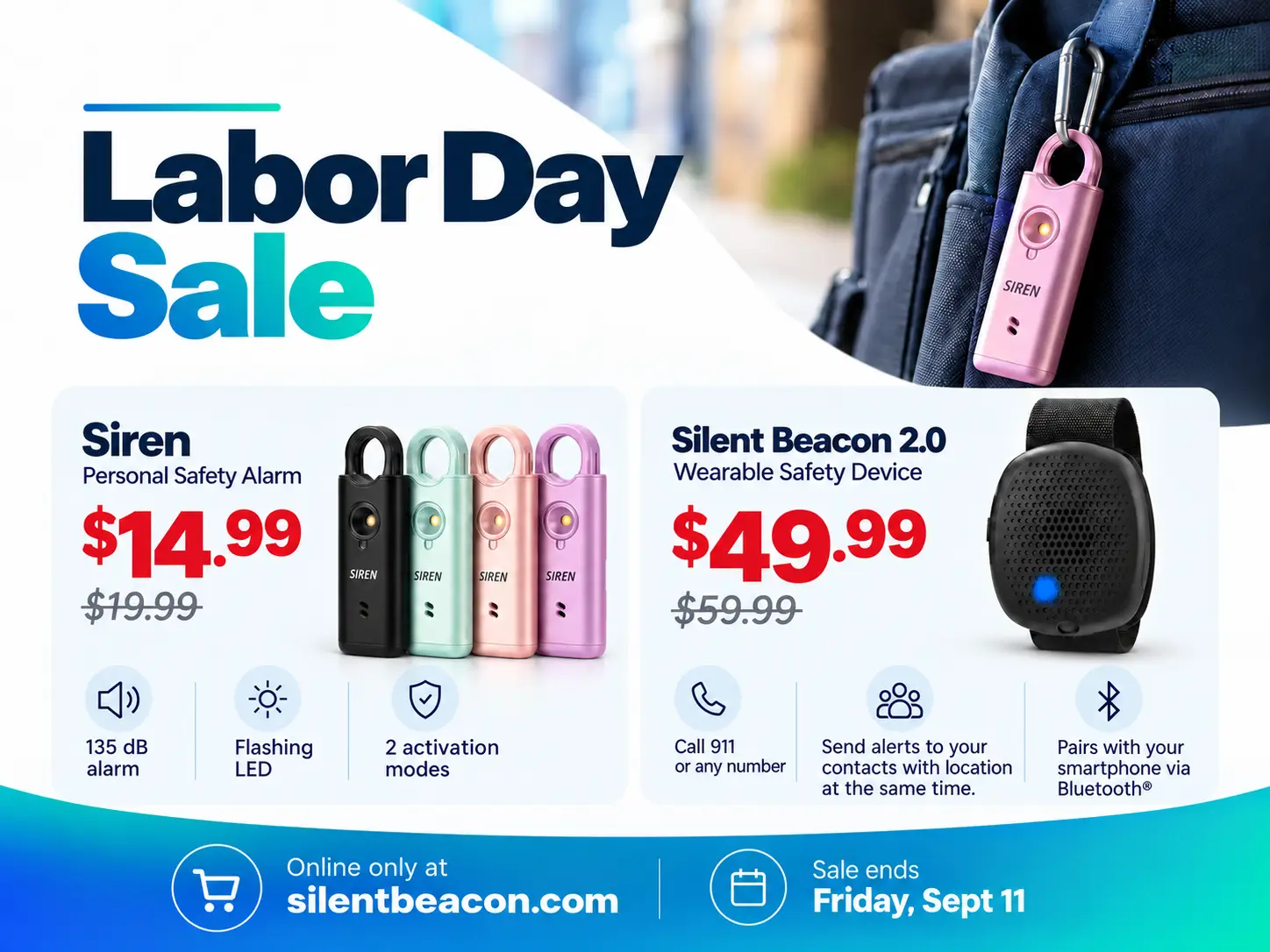
25% OFF THE SIREN PERSONAL SAFETY ALARM.

Save 25% on the Silent Beacon Siren during our Back-to-School Sale with coupon code “BACKTOSCHOOL25”. Don’t miss out!